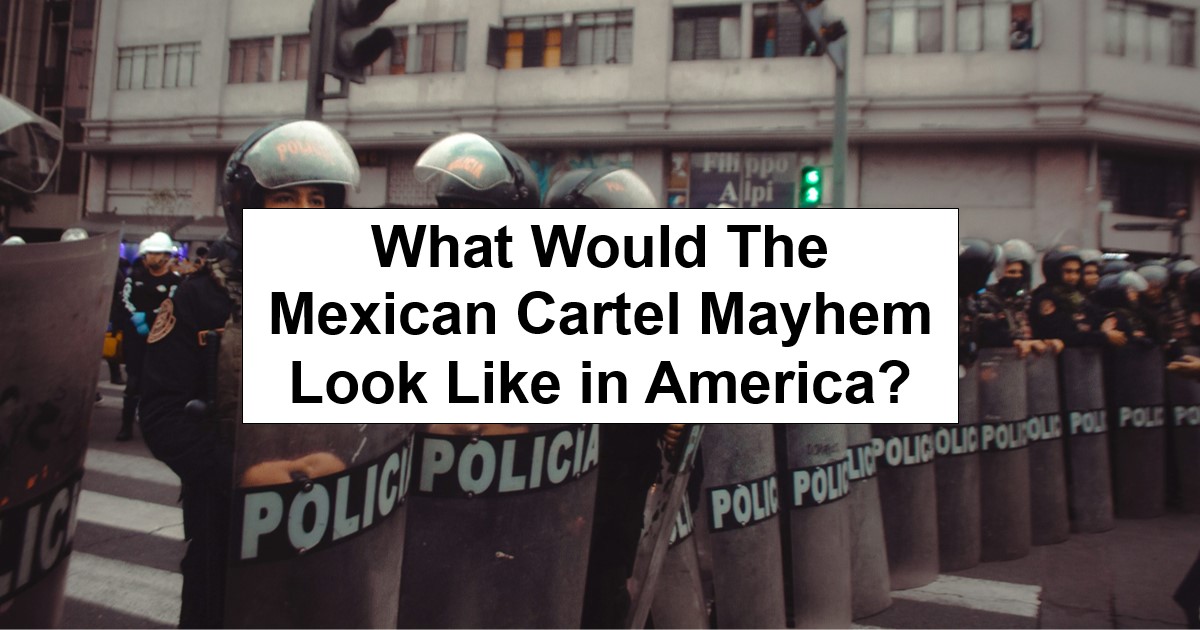
The unfortunate news coming out of Mexico following the death of El Mencho, the leader of the Jalisco New Generation Cartel (CJNG), is something us preppers should be paying attention to. If you haven’t been following it, the situation is essentially a blueprint for how quickly a modern society can descend into absolute chaos. And while Americans tend to look down on Mexico, they’re not a third-world nation:
Mexico has a $1.7 trillion GDP (15th largest in the world), a modern infrastructure, advanced healthcare facilities, high-tech industries, and a large, dynamic service sector.
It is classified by the United Nations as an upper-middle-income economy and is not on the list of “least developed countries.”
According to reports from a week or two ago, the CJNG unleashed a level of violence that turned entire regions into active war zones almost instantly. We aren’t talking about a slow decline over months … it’s blocks being burned, infrastructure seized, and the rule of law evaporating before anyone knew what was happening.
But it appears that things are calming down:
By March 9, 2026, federal authorities reported that roughly 90% of roadblocks had been cleared, and security forces had restored order in most areas. President Claudia Sheinbaum declared that “peace and tranquillity” was returning, though sporadic blockades and debris remained.
It makes you wonder though, doesn’t it? If a single event can cause that much trouble in a country right on our doorstep, what might that mean for us here in America?
The speed of the mayhem is the first thing that jumped out at me. When the thin veneer of civilization was stripped away, it didn’t happen gracefully. In Mexico, we saw how a loosely organized group can paralyze a nation’s population and security forces through sheer, concentrated aggression.
But this isn’t about Mexico’s typical criminal activity running amok. Rather, it’s a demonstration of how fragile the systems we rely on—police, supply lines, emergency services—truly are when faced with large-scale anarchy from a determined group.
But it doesn’t have to be a single group that causes such problems. Remember when we talked about EBT potentially disappearing during last year’s government shutdown? The fear was a possible collapse of decent society because people would’ve literally rioted in the streets without food on the table. But, as usual, government chose to print us into oblivion and push the problem to another day. And, yes, that day is still coming.
The U.S. is a Different Kind of Powderkeg
Now, I know what some people say: “That’s Mexico. It’s different here in America.” And they’re right to a degree, but perhaps not in the way they think. If a similar uprising were to occur in the United States, for whatever reason, the scale and flavor of the violence would be significantly different due to our unique geography and demographics.
For starters, the U.S. has a much larger and more spread-out population, which in some ways is a blessing. In Mexico, the violence is often highly concentrated in specific hubs or along transit corridors, though I suspect the same would be true here, only largely located in major cities and their surrounding suburbs. But I’ll warn you that if you think you’re safe, think again, because you will be directly affected at some point. It’s just a matter of when and in what fasion be that a lack of supplies or outright violence.
Moreover, in the States, our massive geographic footprint means that while some areas might become no-go zones overnight, other areas might remain quiet for a long while. However, that same geographic blessing becomes a real problem for supply lines because so many goods are transported via rail and trucks rather than produced locally. And if our interstate system were compromised by anarchy along any point, those quiet areas could find themselves isolated and hungry very quickly. (Hence one more good reason to stock up!)
Worse, most foreign goods come to the States near the most populated areas along the coasts:
The United States has 10 metropolitan port complexes that handle 60 percent of all international goods by value, according to a Brookings Institution analysis. These top 10 port complexes are the primary hubs for international trade, despite the U.S. having over 300 commercial ports. The most significant of these include the Port of Los Angeles, Port of Long Beach, Port of New York and New Jersey, Port of Savannah, Port of Houston, and Port of Seattle-Tacoma, among others. These ports are critical for global supply chains, managing the vast majority of containerized cargo, energy exports, and imports.
Then there is the wild card that differentiates us from almost any other nation on earth: the sheer volume of firearms. While Mexico has strict gun laws, which has clearly backfired when it comes to defending against the cartels, the U.S. has more guns than people. In a large-scale collapse scenario, you’re potentially dealing with millions of armed individuals, all with different agendas, levels of training, and degrees of desperation. Clearly, the speed of violence in the U.S. might actually be faster because the means to exert force is already distributed across every neighborhood in every county. Again, this is both good and bad.
My question is: How do you even begin to prepare for that level of widespread anarchy when most people barely consider how to prepare for a minor power outage?
Reevaluating the Prepper Mindset
Most people in the preparedness community focus on localized disasters, like a hurricane, a single-day power outage, or brief shortages at the grocery store.
But the CJNG cartel uprising suggests we need to be thinking about something much more sustained and chaotic. Because when the bad guys (whoever they may be) are better armed or more organized than the police, the standard “wait it out and hope for the best” strategy probably won’t cut it.
Clearly, the first step is realizing that the most critical actions happen before bullets start flying. You can’t start hardening your home when the streets are in chaos just like you can’t board up windows as the hurricane rolls in. While I’ve written in the past about how to protect your family during civil unrest, it almost always comes down to reducing visibility and increasing security while there’s still time.
In a scenario where large-scale anarchy is the new normal, at least for a time, you have to look at your home through the eyes of desperate people. I’ve written before about how to harden your home, and while physical barriers are important, they’re only one part of the equation. In a Mexico-style mayhem scenario, home defense quickly transforms into neighborhood defense. After all, if you’re the only one on your block with a stockpile and a plan, you’re just a well-stocked pantry for the first organized group or neighbor who comes through and overwhelms or surprises you.
This also forces us to ask: do you stay or do you go? I’ve weighed 11 different scenarios on whether to stay put or bug out, but the CJNG situation adds a layer of complexity. That is, if the violence is mobile and unpredictable, then bugging out into the unknown might be more dangerous than staying in a familiar environment. On the flip side, if your neighborhood becomes the center of a power struggle, staying put is highly problematic.
The answer is that it depends on the situation. So, you need to prepare for both eventualities.
Final Thoughts: The Lesson of the CJNG
The takeaway here isn’t to live in fear, but to live in reality. We’re watching a real-time example of how quickly what feels like civilization and order can be replaced by raw power. Yes, I know that America is not Mexico, but it’s not as different as many presume.
Whether it’s that economic collapse I continue to fear is coming, a political breaking point that leaves a vacuum, or an EMP/solar flare, the result is often the same: those who are relatively organized and willing to use force will dominate the landscape until a renewed peace is established via a more powerful force.
Obviously, I hope it never comes to that here. But hope isn’t a strategy. History (and current event) continue to show us that the transition from normal to anarchy is sometimes a cliff, not a slope.
Take a look at your current plans. If you saw the same headlines tomorrow but with your city’s name in the lead, would you be ready to lock down, or would you be caught in a mad scramble? Or would you evacuate at the first opportunity or stay and fight? These are tough questions if you’re being honest, but they’re ones you need to answer while the stores are still open and the streets are quiet.
Leave a Reply