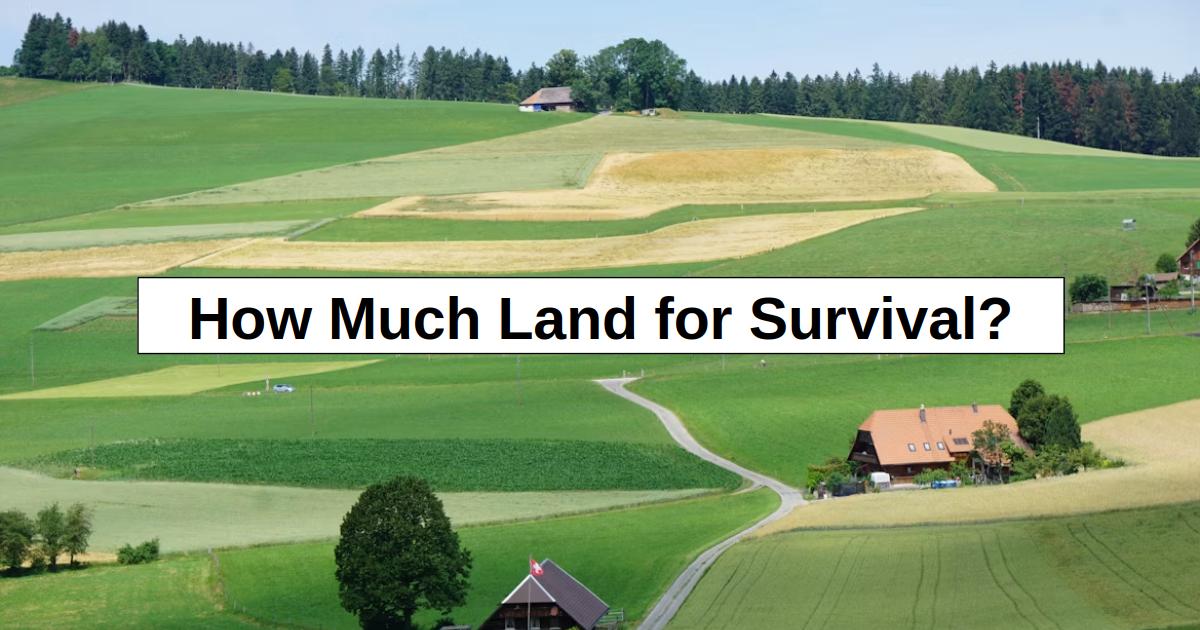
How much land do you need for prepping? Ask that question to any prepper and you’ll get answers ranging from less than an acre to five hundred acres, and everyone will sound completely sure of themselves.
As you might suspect, the answer is that it depends. But that’s not a cop-out. Because it depends on specific things, and once you work through them, you’ll have a much clearer number than any generic recommendation I can give you. Still, I have my thoughts.
Prepping vs. Homesteading
Before you even think about acreage, you need to answer one question: are you prepping or homesteading?
They sound similar but they’re not. Prepping means building supplies and maybe supplementing with some food production. Homesteading means producing most or all of your own food from the land. The land requirements are completely different, and most debates about acreage talk past each other because people are describing two different goals.
The fact is that if you’re a prepper with a solid food stockpile and a garden that adds to it, you need a lot less land than someone trying to go fully off-grid while trying to feed a family from scratch, which likely requires gardens, an orchard, land for animals to graze, and much more.
You’ll need to get clear on which one you’re actually doing before you shop for property.
What Actually Determines Your Acres
Acreage alone doesn’t tell you much. Here’s what does…
Soil quality. Rich loam and sandy clay look the same on a listing but they don’t produce the same food. Knowing your soil before you buy land isn’t optional. Modern farmers might use GPS-guided soil sampling. You don’t need that, but you do need a soil test and some honest research before you sign anything. (I didn’t realize just how clay-ridden our soil is, which makes growing food exceedingly difficult!)
Water access. A property with river frontage, a reliable well, or a spring is a different asset than dry land with no water rights, whereas desert acreage without water access is almost useless for serious food production no matter how many acres you have. If you really want to go off-grid, water is probably more important than soil.
Animals. If you want horses or large livestock in an arid region, plan on multiple acres of forage per animal. Small animals, like chickens and goats, in a wetter climate are a different story entirely.
Wood heat. If you plan to heat with wood, you need trees, and a good number of them. Estimates vary by climate and efficiency, but 20 acres of managed timber is a common floor for true self-sufficiency.
Climate. A quarter-acre garden in the lower Midwest can support two people reasonably well. The same quarter acre in northern Wisconsin might not come close. Cold, short growing seasons demand either more land, more preservation work, or serious supplemental storage or growing efforts, like use of a greenhouse.
My Honest Take Living on 5 Acres
We have five acres. We have a decent garden, some fruit trees, and chickens. I’ll be straight with you because most of it is grass. If we had livestock, we’d use more of it. Without livestock, five acres is more than most people actually need for basic food production.
If I had to pick a number for what a dedicated prepper needs to grow meaningful food, I’d say one good acre, used well, is enough. Good soil, water access, and a solid plan beat ten mediocre acres and no plan every time. I’ve seen people do impressive things on a quarter acre, and I’ve seen people do nothing with fifty. I’m somewhere in between.
And believe it or not, buying canned goods is often cheaper than growing and canning your own once you factor in time, equipment, loss due to pests and vermin, and a host of other problems.
Why More Land is Better
Here’s where I’ll contradict myself a little, because I think it’s worth doing so: Food production and wood for heating isn’t the only reason to want acreage.
A buffer zone matters. If things go sideways like I believe they will at some point, you want distance between your family and whatever’s happening nearby. Neighbors you can’t see are neighbors who can’t see you. I’ve written about understanding the worth of your land before, and buffer distance is part of that calculation.
More land also gives you options. It’s room to expand the garden, add more animals, plant a woodlot for future generations, maybe build additional structures for gardening, storage, or whatever. It’s may be land you don’t need today, but could be exactly what you need in five years.
Privacy, security, and flexibility are legitimate reasons to want more acres than your food plan minimally requires. But just be honest with yourself because land isn’t cheap … and if it is cheap land, then it might not be the best choice.
The Time Problem
Either way, more land means more work. That sounds obvious, but most people don’t feel it until they’re living it, which is what we’ve discovered.
Even on five acres, it’s easy to feel behind. Mowing alone eats up an entire day. Add animals and you’ve got hooves to trim, sheds to muck, feed to haul, fences to fix. One experienced homesteader I came across said he mows every 7-10 days just to keep ticks under control! That’s before any actual food production concerns.
And this only gets harder as you get older. The 100-acre dream that sounds great at 35 might break you at 65. Whatever number you land on, be realistic about what you can actually manage as time passes. I cover some of this in how to plan and prepare your homestead land if you want to think through the practical side.
Community Multipliers
Are you intending on doing this alone? Because a group of like-minded people working together can produce far more from less land than any solo operation. It could be that one person grows corn, another tends livestock, and someone else runs the orchard. What you don’t produce, maybe someone nearby does while long-term storage fills the gaps. Either way, it’s time you can spend doing something else.
My Rough Answer
For a small family in a decent climate with good soil and water access, most people point to 5-20 acres as a reasonable range for serious food production, animals, and a woodlot. That number will be significantly less if you’re in a cooperative community or have nearby neighbors who you can trade with. On the other hand, that number will be more if your climate is harsh, you’re heating solely with wood, or you want a meaningful buffer and privacy from neighbors, like we talked about.
If you’re just starting out and wondering what to look for, my post on land acquisition for a homestead walks through the process. And if you want a broader framework for getting your whole preparedness setup in order, my book covers a lot of the ground people overlook when getting into preparedness for the long-haul.
Ultimately, most people overestimate how much land they can manage and underestimate how hard even a small plot works them. Whatever number you’re eyeing, cut it in half, see if you can handle that first, then scale up unless you know for a fact you’ll want that buffer.
What’s your situation? Do you have land already, or are you still in the planning stage? How well are you managing the land you’re on?
Leave a Reply