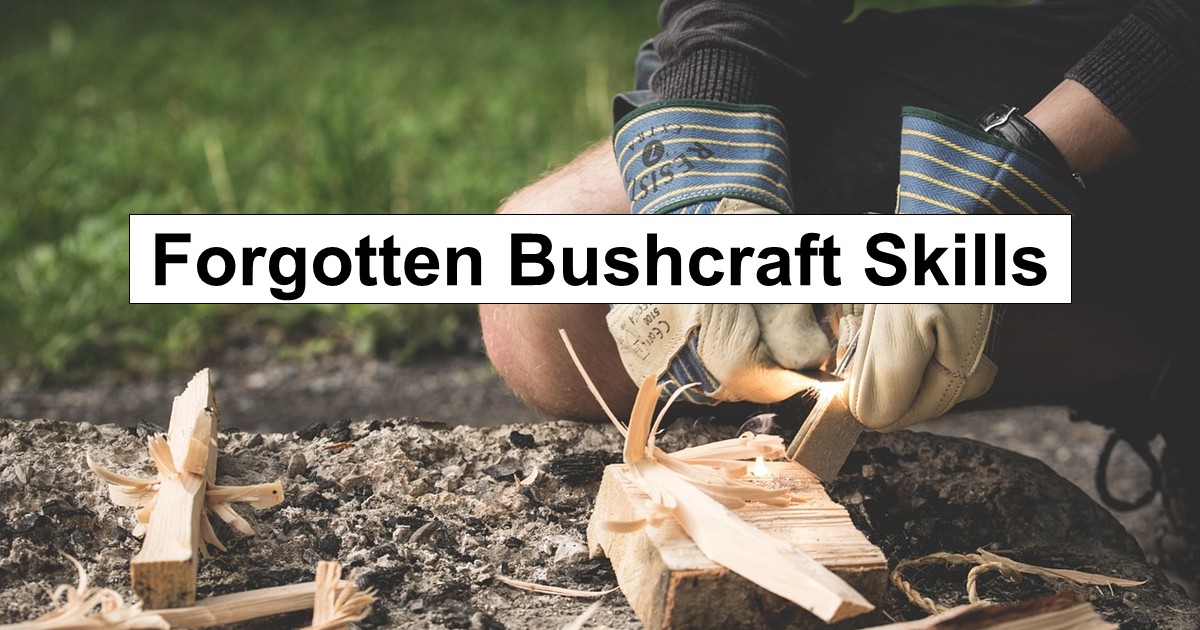
The 21st century is the century of technological development, and this applies to bushcraft as much as it does to informational technology. We’ve become perhaps a bit too reliant on our phones as the ultimate survival devices, with GPS, compass, and a wealth of survival knowledge all available on a small rectangle that we carry in our pockets every day. What if that rectangle stops working, though? What if there’s no GPS, no digital compass, and no Google to help you out? At that point, it’s time to go old school.
Using a Map and a Compass
Navigating with just a map and a compass is by far the most important forgotten bushcraft skill that everyone should learn. Sure, your GPS may be the most reliable navigation tool as it does everything you can do with a map and a compass, but with even more accuracy. But what if you forget it in your car? What if your phone battery runs out?
You should always have a map and a compass, and know how to use them, just in case something like that happens.
Compass Basics

Image: https://pixabay.com/photos/compass-orientation-map-address-5261062/
Before you even begin using a map, we need to learn how to use a compass first.
This is Navigation 101, but let’s go through it anyway.
Compasses have a magnetized needle that’s always pointing north. Aside from north (usually marked with ‘N’ on your compass, while the northern part of the needle could also be painted in another color), there is also south (the opposite side of the needle), west (left-hand side when facing north), and east (right-hand side when facing north).
To use a compass, all you have to do is:
- Hold it out flat on your palm
- Turn until your body is facing the same direction as the needle
Congratulations – you’re facing north! See how easy that was?
Navigating With a Compass Alone
Compasses and maps are designed to be used together, but you can use each tool individually to navigate.
To get out of a tight spot with a compass alone, you need some local geographic knowledge up front. For example, suppose you’re going on a hike in a large forest on your own. In that case, it’d be smart to make a note of the general location of populated areas and useful locations.
If you know that there’s an emergency phone in the woods, make a note of its general location. Also, note the location of any hunting cabin you know of, any nearby farms, villages, towns, and roads.
That way, if you get lost, you’ll know which way to head. Hypothetically, if you get lost in the eastern part of the woods and you know that there’s a farm just a few miles off the east edge of the forest, all you have to do is follow your compass in that direction until you reach that location.

Image: https://pixabay.com/photos/bosnia-balkan-europe-landscape-8410601/
To follow your bearing, you should rely on a method called bounding. This refers to tracking down specific objects instead of following the direction indicated by the arrow on your compass. To put it in even simpler terms: instead of heading in a direction (in this example, that direction is ‘east’), we’re going to break that path into milestones.
For example, if we’re going east, you should find the general direction of east on your compass and locate an easily identified and easily tracked trail marker. A hill, a very peculiar-looking tree, a cave, a valley; all of these things can be trail markers.
It’s important that a trail marker is immobile. Even though tough guys do it in movies, you shouldn’t follow the sun or a flock of birds.
Follow the first trail marker to head east, and when you reach it, pull your compass out again and find another marker that’s more or less located due east. Repeat the process until you reach your location (in this example, the edge of the forest).
This is a slow navigation process with a relatively thin margin for error (mostly because people don’t know how to use compasses). However, it is the oldest and most basic form of navigation. Just locate a trail marker and follow it.
The only way you could mess this up is if you have operational issues with your compass, and here are the most common problems (and their respective solutions).
Most Common Compass Problems
By far the most common issue with a compass is the needle mindlessly spinning around, seemingly unable to find north. The most common cause for this is electronic devices (such as your phone) or other magnets messing with the magnetic field. Put everything on the ground and move a bit away from it.
If your compass still doesn’t work, walk even further away – small, local electromagnetic discrepancies occur all over the planet, and they can mess with your compass.
Aside from that, the most common compass problems are air bubbles in the compass liquid and the compass needle sticking, unable to move. Unfortunately, there’s not much you can do about this in the field. Both issues require disassembly and replacement of components (or outright purchasing a new compass).
This is why you should always check your compass before leaving on a trip.
Add a Map to the Mix
A map is to a compass what peanut butter is to jelly. If you know how to read it, which is actually very simple, it grants you sight beyond what you can physically see from your location, and that way, you can plan a route to get yourself back home.
To do this, the process is simple:
- Find your own (approximate) location
- Find the closest location where you can find help
- Find the shortest route to it
Finding Your Location on a Map

Image: https://pixabay.com/photos/compass-map-navigation-626072/
Locating your position on a map involves triangulation. To start, put your compass on your laid-out map and turn the map (with your compass on it) until the map’s north (usually on the top side of the map, sometimes marked with ‘N’) aligns with the compass’s north.
Then, you need to find three easily identifiable markers you can see from your location. Hills, peaks, and rivers; all of these features will be marked on a map, allowing you to use them to locate your position. If you can’t see anything helpful, get yourself to a vantage point before you start looking for your location.
To locate a hill or a peak on the map, look for contour lines (also known as topographic lines). These lines typically resemble irregular, oddly shaped circles, and their steepness is indicated by the lines converging closer and closer to one another. The height is often shown within the lines, and the shape of the lines is a 2D depiction of the actual 3D shape of hills and mountains.
Rivers and lakes are marked blue on maps, and you can find the meaning of all the symbols in the map legend (usually found in the corner of the map or on the other side).
You need to find two, but preferably three, locations on the map that you can see from where you’re standing. Then, you need to find the azimuth toward each location (the angle at which you’re looking at them; you’ll find the exact numbers alongside the outer edge of the compass), and draw the counter-azimuth with a pencil (or anything else that will leave a mark) on the map.
The simple formula for calculating counter-azimuth is:
- If the azimuth is between 0 and 180 degrees, add 180.
- If the azimuth is between 180 and 0 degrees, subtract 180.
The three lines will cross at roughly a single point, and that’s roughly your point!
Planning a Route with a Map
Planning a route with a map is much easier than doing it with a compass alone.
Once you locate the place you want to reach and determine your location, all you have to do is identify the obvious trail markers on the map and plan how to follow them.
For example, a river or a stream might be roughly directed toward that location, and if that’s the case, it’s best to stick with it. Maybe halfway there, the river turns west, and you need to go east. That won’t be a problem, because you’ll find something else. Maybe there’s a very visible peak due east, and you just have to walk through it.
You get the gist. Follow these landmarks until you reach your location. If you think you’re losing the bearing at any point, repeat the same process with your map and your compass.
When you think about it, your GPS does pretty much the same thing; it’s just that it does it much faster, more accurately, and it updates your location and the trail you should follow in real time.
Knife Skills

Image: https://pixabay.com/photos/igniter-to-carve-woodblock-prints-1598271/
Another traditional aspect of bushcraft that is often overlooked nowadays is knife skills. Sometimes, this involves shaving dry wood into curls (this is also known as feather sticking) to create tinder as you’re preparing a fire. Other times, you’ll need to use a knife to carve notches in branches for traps or even shelter construction.
Knife skills are also important for cooking. Today, most people prepare hiking food in advance, as more and more people forget or never learn how to gut a fish or prepare an animal for dinner. A lot of people make a big deal out of catching food in the wild, but no one asks themselves what they’re going to do with it when they actually do catch it. If you were in an unexpected survival situation, being able to catch and prepare your own food would be a critical skill.
Preparing a Fish
You should actually pray that you catch a fish instead of a rabbit because they’re much easier to prepare.
You’ll first of all need a good bushcraft knife to get started.
Remove the scales by scraping the blade from the tail to the head while washing the fish in fresh water. Then, cut the fish open from tail to head, alongside the belly, and remove the entrails by hand. Literally, just rip them out. If something is going to bother you or gross you out about this whole process, it’s usually this step.
Rinse the insides well, and the fish is basically ready to go. See? Easy.
Preparing Game
Catching and preparing wild game, however, is a more challenging task. The reason preparing game is more difficult is that skinning takes more effort than removing fish scales. It is also a much more time-consuming process that can vary depending on the animal. Deer and elk have a similar process to each other, but a wild pig is going to be different. Look up techniques for the game you are most likely to encounter before you head out, or put some guides in your survival bag just in case.
Regardless of what you’re preparing, you will need to field dress it sooner rather than later to prevent bacteria growth, spoilage, and to cool down the meat. When you are doing this, make sure you do it away from your camp. The remains can attract predators, and depending on where you’re located, that could be inviting a mountain lion, wolves, or a bear to join you if you aren’t careful.
Primal Skills Rule The World
Even though we’re accustomed to modern technology and these skills aren’t as necessary nowadays, knowing how to use a map and a compass, as well as how to butcher an animal, are crucial components of the foundation of a modern survivalist’s knowledge pyramid. Although it’s unlikely that you’ll actually need it, it’s something that you can always rely on if the worst comes to worst, and it’s not difficult to learn, so why not invest a bit of time in yourself and learn skills that were once crucial to our survival?
Leave a Reply