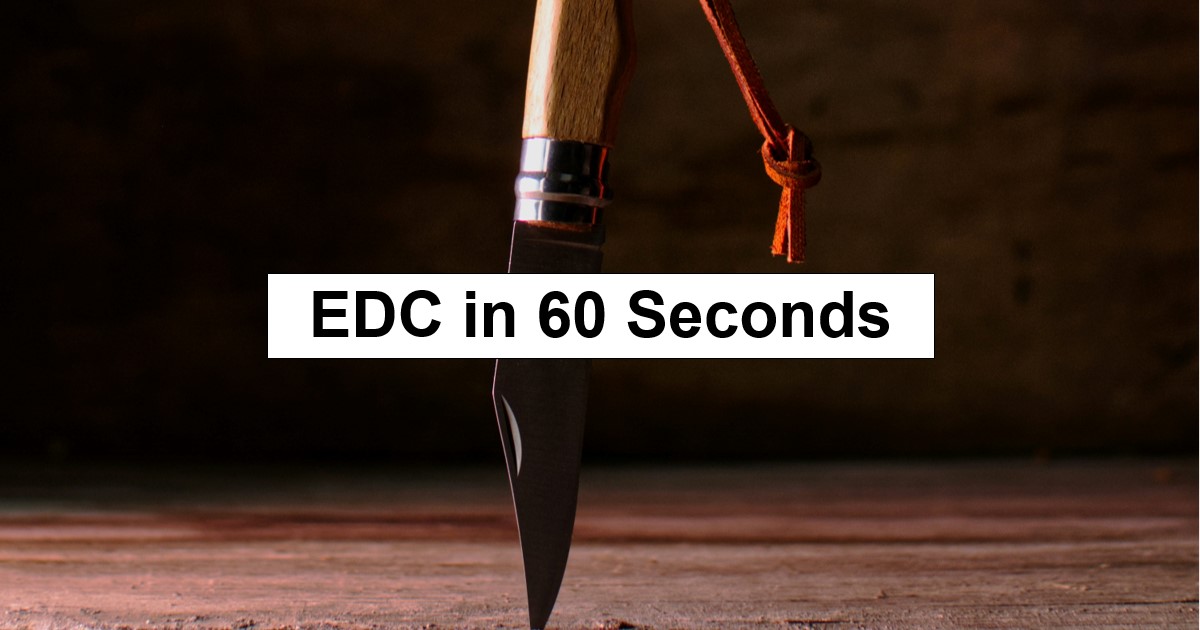
It is incredibly easy to get sucked into the “tactical” side of preparedness, especially when it comes to Everyday Carry (EDC). We see photos of people carrying three knives, two flashlights, a fire-starting kit, and enough paracord to rappel down a skyscraper. While that gear looks great in a curated photo, the reality of daily survival is often much more mundane and focused on practical, evidence-based needs than what social media suggests.
I recently watched this 60-second video by The Urban Prepper that shows his view of what we should actually be carrying. But, in my humble opinion, it’s still a bit much:
Sadly, we often prepare for the 1% of scenarios (like being lost in the woods) while ignoring the 99% of situations we actually face every day. Clearly, the most important survival actions (and gear) are those that help us navigate our current society rather than a post-apocalyptic wasteland or wilderness survival scenario that are far less likely.
What You Should Focus On
When we talk about survival, we usually think of “hard” gear. However, in an urban or suburban environment, your ability to communicate and interact with others should be a primary survival focus.
In almost every modern emergency, from a car breakdown to a sudden localized natural disaster, your phone is your lifeline. It is your map, your communication hub, and your way to call for help. Along those lines, cash is still king. While I’ve discussed stockpiling essential supplies for the long term, having physical currency on your person is a critical short-term survival strategy. Because when credit card systems go down, a twenty-dollar bill still spends.
Obviously, this doesn’t mean you should ditch all your EDC survival gear; take with you what you feel you need. But I will suggest that your EDC should be personalized to your actual life and not a fictional movie scenario that is unlikely. For instance, if you spend ten hours a day in an office, a bulky survival tin full of fishing hooks probably isn’t the best use of your pocket gear. How about a backup power bank to keep your phone charged instead?
My Approach to EDC Today
I’ll be the first to admit that I used to carry way too much gear. I had the itch to be ready for every conceivable disaster at a moment’s notice … so much so that I purposely wore cargo pants or shorts just to carry more stuff, lol.
Over time, and through reflecting on how I actually live my life, I have transitioned to a much more streamlined setup. My current EDC focuses on the essentials: my smartphone, a quality pocket knife, a small flashlight, and extra cash tucked away. That’s about it.
I still believe in the utility of a good multi-tool, which I will take with me on occasion, and I’ve written before about why a Leatherman Wave belongs in your EDC if you have the space for it. It provides a level of versatility that a standard knife just can’t match.
For those looking to dive deeper into selecting the right gear without going overboard, I discuss strategies for practical preparedness in my Everyday Carry book that goes well beyond what you carry in your pockets. As with all things, the goal is to find a balance between being ready and being burdened.
Ultimately, the most effective EDC is the one you actually have in your pockets when things go wrong. Keep it simple, keep it functional, and make sure it serves the life you’re actually living today because fantasies should be left to the unprepared masses.
Leave a Reply