In January 1978, a blizzard buried much of Michigan. I was in college then, living in a co-op house with a bunch of other students, and somewhere in the middle of that storm the power went out. That was the moment we stopped knowing anything. There was no television, no radio plugged into the wall, and no way to find out how bad things were getting beyond the window. Cell phones did not exist yet for ordinary people, so there was not even a phone to check and be disappointed by.
We were not in a remote cabin. We were in a house full of people, in a town, and we were completely cut off from information. We did not know whether roads were open, whether the storm was about to ease or get worse, or whether anyone was coming to plow. We guessed, we argued about it, and we waited.
Nearly fifty years later, most of us carry a phone that can deliver a warning in seconds. It is tempting to think the 1978 problem is solved. It is not. It has just changed shape. The same storm that takes down power lines can also overload or knock out the cell towers your phone depends on, and a dead or silenced phone is exactly as useless as no phone at all. If you want to keep getting emergency alerts when the grid and the cell network fail, you need a plan that does not depend on either one.
This article walks through how to build that plan: why phones fail at the worst moment, what a NOAA weather radio actually does, how S.A.M.E. county alerts work, how to keep a radio powered through a long outage, and how to turn all of it into a simple routine your whole household can follow.
WHY YOUR PHONE IS NOT ENOUGH
Phone alerts are genuinely useful. Wireless Emergency Alerts push warnings to phones in an affected area without any app or sign-up, and they have saved lives. The trouble is the list of things that all must go right for one to reach you.
First, the phone must be charged. In a long outage, charge is the first thing you do, and every hour you spend checking the news is an hour of battery you will not get back. Second, the phone must be on and within reach. A phone on silent, charging in another room, or switched to a sleep or do-not-disturb mode will not wake anyone at 3 a.m. Third, the towers have to be working. Cell sites have backup power, but it is not unlimited, and during large storms and disasters networks can be damaged or jammed with traffic as everyone tries to call at once.
Those are three separate points of failure, and a severe storm can trigger all three at the same time. That is why emergency managers keep saying the same thing: have more than one way to get a warning. The goal is not to give up your phone. It is to make sure a single failure does not leave you in the dark, the way my co-op house was in 1978.
WHAT A NOAA WEATHER RADIO ACTUALLY DOES
NOAA Weather Radio is a nationwide network of radio stations run by the National Weather Service. It broadcasts weather forecasts, watches, warnings, and other hazard information around the clock on its own dedicated frequencies. Those frequencies sit in the VHF band, from 162.400 to 162.550 MHz, split across seven channels. They are not AM or FM, which is why a standard kitchen radio cannot pick them up. You need a receiver built for the weather band.
The important point is that this system is independent of the cell network and of the internet. A weather radio only receives a broadcast signal, and it can do that on batteries. Typical reception range is roughly 40 miles from a transmitter, though hills, buildings, and distance can cut that down, so it is worth checking the coverage map on the National Weather Service website for your location before you buy.
The second thing a good weather radio does is alert you. Most models have an alert mode where the radio stays silent until a warning or watch is issued, then sounds a loud tone and switches on the broadcast. That is the feature that matters at night. The radio that you turn on and tune is a nice backup. A radio that wakes you up is a safety device.
S.A.M.E. ALERTS: GETTING WARNED ABOUT YOUR COUNTY, NOT THE WHOLE REGION
If you have ever lived near the edge of a broadcast area, you know the problem. A basic weather radio can go off for warnings that cover a dozen counties, most of which have nothing to do with you. After a few false alarms people learn to ignore it, or they unplug it.
S.A.M.E. solves this. The letters stand for Specific Area Message Encoding. Each alert carries a code that identifies the county or counties affected, and a radio with S.A.M.E. capability can be programmed with your county code so that it only sounds for alerts that include your location. You can find your county code on the National Weather Service Weather Radio website. Many people program their own county plus one or two neighboring counties, so they get a little early notice of weather heading their way.
Programming takes about five minutes with the manual in hand, and it is the single most useful thing you can do to make a weather radio trustworthy. A radio that only speaks up when it matters is a radio that people leave plugged in and turned on.
One caution on settings. Some people turn off certain alert types because the radio sounds too often. Think twice before doing that for tornado and severe thunderstorm warnings, or for winter storm and flood alerts if those are your region’s main hazards. The inconvenience of an occasional alert is small compared with the cost of missing the one that counts.
WHERE TO PUT IT, AND WHICH KIND TO BUY
Most households are best served by two radios that do different jobs.
The first is an always-on home alert radio. This is a plug-in unit, typically with S.A.M.E. programming and battery backup, that lives near where you sleep. The key detail is the battery backup. A radio that depends only on wall power goes silent during exactly the power outage you bought it for. If you buy a plug-in model, confirm it has a battery compartment, install fresh batteries, and keep them replaced.
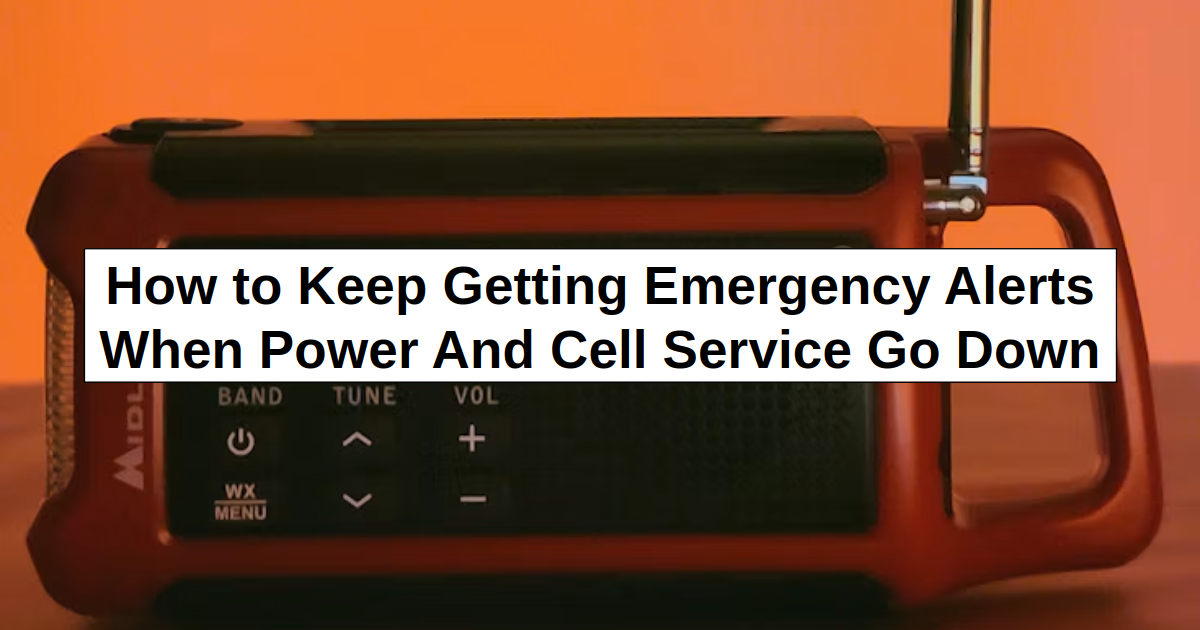
The second is a portable emergency radio. This is the one that goes in the go-bag, the car, or the hall closet. The best ones run on several power sources at once, including batteries, a hand crank, a small solar panel, and a USB connection, and many include a flashlight and a port that can add a little charge to a phone. They are a good match for a multi-day outage, a camping trip, or an evacuation.
If you want to compare specific models, I put together a side-by-side guide to the options at https://readyabode.com/best-noaa-emergency-weather-radios/, covering plug-in alert radios, crank and solar portables, and a compact travel radio. Whatever you choose, there are a few features worth insisting on:
- Explicit NOAA weather band reception. Some radios sold as emergency radios cover AM, FM, and shortwave but treat the weather band as an afterthought. Make sure the weather channels are clearly listed.
- S.A.M.E. programming on the unit you will leave on at home, so it only wakes you for your own area.
- More than one way to power it. Battery plus crank plus solar is the usual combination on portables. For a home unit, wall power plus battery backup is the minimum.
- A telescoping antenna, or an external antenna jack, if your reception is marginal. The smallest radio will tend to have the weakest reception.
Placement matters as much as the model. Put the home radio where you will hear it from the bedrooms, at or above head height, and near a window if your signal is weak. Do not tuck it behind a TV or a metal shelf. If you cannot hear it from every sleeping area, a second unit is cheaper than a missed warning.
POWER: KEEPING THE RADIO ALIVE THROUGH A LONG OUTAGE
A weather radio uses very little electricity when it is simply listening, which is what makes it such a good fit for an outage. Even so, it will not run forever on nothing, so the power plan deserves some thought.
Batteries are the workhorse. Fresh alkaline batteries in a radio on standby can last a long time, but cold weather cuts battery performance sharply, and winter storms are exactly when you need the radio. In cold climates, lithium AA batteries hold up better in low temperatures and store longer, and they are worth the extra cost for a radio you rely on. Keep a spare set with the radio, not in a drawer across the house.
The hand crank is a backup of last resort. Cranking turns your effort into a modest amount of listening time, so it is wonderful when batteries are dead and nothing else is available, but nobody wants to crank for hours. Treat it as a safety net, not the plan.
Solar is slow and depends on the weather. During a winter storm the sun may not be much help for days. A small solar panel on the radio is a reasonable bonus in summer storms and on camping trips, but it should not be your only source.
A last option is a rechargeable power bank or a larger portable power station, which can top up a radio, a phone, and a few other small devices. If you already own one for other outage needs, add the radio to its list of things to charge. If you do not, it is a reasonable next step, though the radio itself will keep working well without one.
One habit pays for itself. Tie battery checks to something you already do twice a year, such as changing the clocks for daylight saving time. When the clocks change, test the radio, replace the batteries in your home unit if they are more than a year old, and check that the portable one still powers on.
LAYERS: WHAT ELSE GIVES YOU WARNING
A weather radio is the backbone, but the strongest plan has layers, because different failures hit different tools.
Your phone is still the first layer for most people. Keep wireless emergency alerts turned on in the phone settings and consider a weather app or your local National Weather Service office’s feeds for detail. Just do not make the phone the only layer.
A battery-powered or car radio is another. Local AM and FM stations carry emergency information, and many broadcasters are built to stay on the air during disasters. If the power is out at home, your car radio, running on the car’s battery, is a perfectly good way to listen. Run the engine briefly with the car outdoors, never in a closed garage, so you do not drain the battery or risk exposure to exhaust.
Outdoor warning sirens are the old-fashioned layer, and many communities still rely on them. They are designed to warn people who are outside, not to wake people inside, and they may not be audible in a house with closed windows or in a heavy storm. Do not count on a siren to be your bedroom alarm.
Neighbors are a layer too, and an underrated one. In 1978, the information that eventually reached my house came from people, not machines. Knowing who on your street has a radio, who has a generator, and who might need help makes everyone safer.
BUILDING A SIMPLE HOUSEHOLD ALERT PLAN
Equipment does nothing without a plan, and the plan does not need to be elaborate. It needs to answer a handful of questions so that nobody is improvising when the lights go out. Here is a version that a family can set up in an afternoon:
- Decide which alerts matter most where you live. Tornado and severe thunderstorm warnings, winter storm and ice warnings, flash floods, wildfire, and hurricane alerts are all different. Choose the ones that fit your area and make sure your radio is set to sound for them.
- Get a home alert radio and program it. Look up your county code, enter it along with a neighboring county or two, and place the radio where you will hear it from the bedrooms. Check that the battery backup is installed.
- Put a portable radio where you can grab it. Keep it with the flashlights or in the go-bag, with a spare set of batteries beside it, so that when the power goes out in the dark, you know exactly where it is.
- Agree on what you do when an alert sounds. Decide who checks the radio, where the family goes for a tornado warning, and who is responsible for waking children or older relatives. Write it down and put it on the refrigerator, not just in your head.
- Test it. Many National Weather Service offices run regular test alerts, often on Wednesdays. Check your local schedule and use the test to confirm your radio sounds and everyone can hear it from where they sleep.
- Practice once a year. Walk through a simulated outage. Turn off the power and your phones, get the family together, and see how fast you can find the radio, get a signal, and reach your safe spot. The mistakes you find in a drill are the ones you will not make in a real storm.
- Maintain it. Replace batteries on a schedule, keep a spare set, and review the plan whenever someone moves in or out of the household, or you change where people sleep.
COMMON MISTAKES TO AVOID
A few errors come up repeatedly. People buy a plug-in radio with no battery backup and discover it is silent in an outage. People buy a radio that lacks the NOAA weather band entirely. People never program the S.A.M.E. code, then get tired of false alarms and unplug the thing. People rely on a single phone and a single charger. And people store the radio in a closet with dead batteries, where it sits untested for five years.
None of these mistakes are hard to fix. They simply have to be noticed before the storm, which is exactly what the checklist above is for.
WHAT I WOULD DO DIFFERENTLY IN 1978
If I could hand my college self a single thing in that cold, dark house, it would be a small radio running on batteries and tuned to the weather band. It would not have stopped the snow. It would have told us what was coming, how long it would last, and what the authorities were asking people to do, so we could have made decisions based on facts instead of guesses.
That is what an alert plan really buys you. It does not prevent the emergency. It shortens the time between something happening and you knowing about it, and in a tornado, a flash flood, or a winter storm, those minutes can matter a great deal.
You do not need a bunker, a stockpile, or an expensive setup to start. You need a radio that will wake you, a way to power it when the grid is down, and a plan the people in your house actually know. Do those three things this month, and the next time the power goes out in a storm, you will not be wondering what is happening outside. You will already know.
AUTHOR BIO
Dianne Bright writes practical emergency-preparedness guides for families at ReadyAbode.com. She has been through a few power outages, including the Great Blizzard of 1978 in Michigan, and believes every household should have a way to get a warning when the lights go out.
Leave a Reply