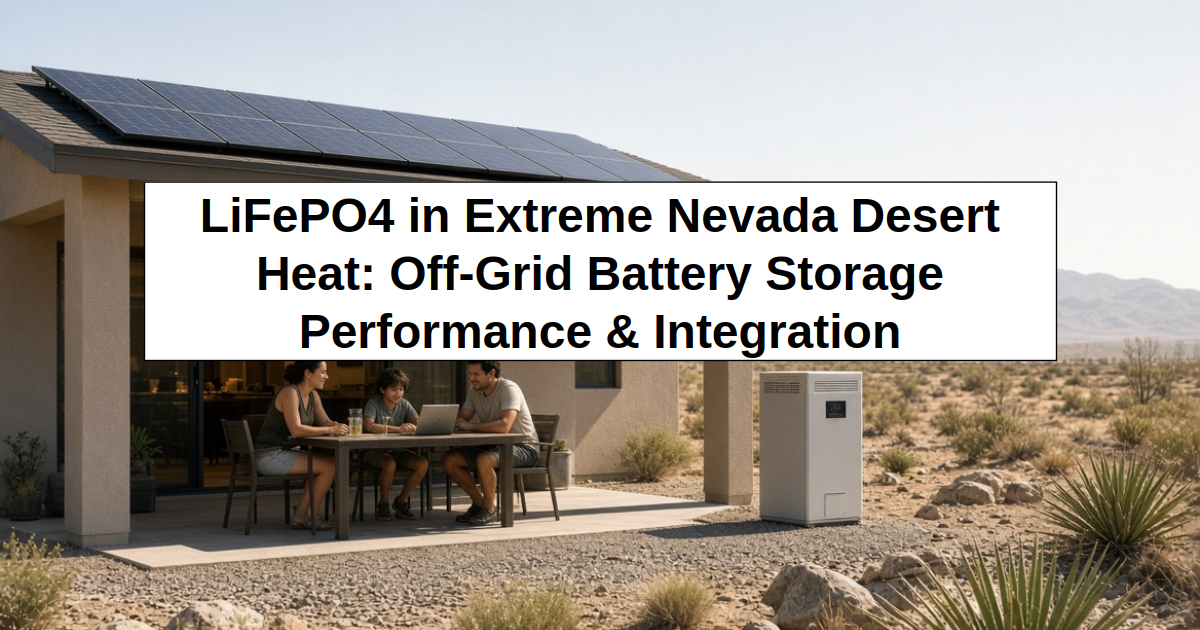
When the grid drops in Las Vegas or North Las Vegas on a 110°F+ summer afternoon, your home’s battery storage suddenly becomes the line between keeping the refrigerator running, lights on, and room cool—or sitting in the dark with a melting freezer. In the Mojave Desert, battery chemistry isn’t just a technical spec; it’s a performance metric. Lithium iron phosphate (LiFePO4, or LFP) has emerged as the standard for residential and off-grid solar storage because it tolerates high ambient heat, endures heavy daily cycling, and offers a superior safety profile compared to older lithium chemistries.
This guide breaks down how LiFePO4 batteries handle Southern Nevada’s extreme summer heat, how they perform during multiday grid outages, and the practical steps you can take to maximize their lifespan and reliability.
LiFePO4 Explained: Why It Dominates Home Energy Storage
Lithium iron phosphate (LiFePO4, or LFP) is a lithium-ion chemistry that relies on iron phosphate for its cathode rather than the nickel-manganese-cobalt (NMC) or nickel-cobalt-aluminum (NCA) blends common in electric vehicles and early-generation home batteries. At the chemical level, the iron-phosphate crystal lattice is exceptionally stable under heat. That built-in thermal resistance is precisely why LFP has become the go-to standard for residential solar energy storage and off-grid power in high-temperature environments.
Modern 2026 datasheets rate quality LiFePO4 home batteries for 3,000 to 6,000+ full charge cycles before dropping to 80% capacity under standard room-temperature conditions. They deliver over 90% round-trip efficiency and allow an 80% to 100% depth of discharge—giving you access to virtually all your stored energy without the steep lifespan penalty lead-acid batteries suffer below 50%. Paired with a significantly higher thermal runaway threshold, these performance metrics explain why LFP has rapidly displaced both lead-acid and NMC for new solar installations in Nevada.
The vast majority of solar storage systems installed across Southern Nevada—including the Tesla Powerwall 3, Enphase IQ Battery 5P, FranklinWH aPower, and modular 48V server-rack systems—utilize LiFePO4 chemistry. Installers favor LFP because it simplifies thermal management, lowers warranty risk in unconditioned garages that easily pass 110°F, and easily handles the dual demands of daily solar self-consumption and extended emergency backup. For homeowners, that translates directly to a longer operating lifespan and an essential thermal safety buffer during extreme desert summers.
LiFePO4 isn’t magic. High ambient heat still accelerates cell degradation, and a reliable Battery Management System (BMS) remains essential to strictly enforce safe charge and discharge thresholds. What LFP delivers—unlike its alternatives—is a significantly slower rate of heat-induced aging and a much wider operating buffer before reaching thermal runaway. In a desert climate where summer temperatures routinely push garage and outdoor enclosures past 100°F, that combination of durability and safety is precisely why LiFePO4 powers the vast majority of new Nevada installations. .
Temperature Ratings and What Happens Above Optimal
LiFePO4 datasheets outline three distinct temperature metrics that homeowners often mix up: the broad range where the battery can operate, the optimal band where it lasts longest, and the hard safety thresholds enforced by the Battery Management System (BMS).
Most quality residential LiFePO4 batteries feature distinct operating boundaries:
- Discharge Range (–4°F to 140°F / –20°C to 60°C): The broad window where the battery can deliver power to your home.
- Charge Range (32°F to 113°F / 0°C to 45°C): A much stricter envelope. Below 32°F, the BMS halts charging to prevent severe cell damage from lithium plating. Above 113°F, it throttles or pauses charge rates to limit thermal stress.
It is important to view these spec sheet numbers as extreme survival limits rather than optimal operating conditions.
The ideal sweet spot for minimizing cell degradation is 59°F to 95°F (15°C to 35°C). Within this temperature window, parasitic side reactions remain slow, calendar aging stays minimal, and the cycle-life ratings listed on the datasheet hold true. However, when average cell temperatures spend extended periods above 95°F to 104°F (35°C to 40°C), those chemical side reactions accelerate. Internal resistance climbs and capacity fade speeds up. While the battery will continue to operate under BMS protection, every year spent in high desert heat burns through more of its total cycle budget than a year spent at room temperature.
During a Southern Nevada summer, an unshaded exterior wall or poorly ventilated garage easily maintains ambient air temperatures above 110°F (43°C) for days on end. Internal cell temperatures run even hotter—typically rising another 10°F to 15°F above ambient during moderate charge and discharge cycles. The practical result? A home battery installed without shade or active airflow will spend most of June through September operating outside its optimal thermal window, silently accelerating cell aging even if it never triggers a BMS shutdown.
Manufacturers publish wide operating ranges because LiFePO4 chemistry is exceptionally tolerant—not because high heat comes free. A pack maintained at an average 77°F (25°C) will deliver very close to its full advertised cycle life. That same pack operating at an average 104°F–113°F (40°C–45°C) remains safe and functional, but it will drop to 80% capacity in significantly fewer cycles. This degradation gap is precisely why smart mounting locations and proper airflow yield far greater real-world ROI than minor spec-sheet differences between competing LiFePO4 brands.
Cycle Life and Degradation in Sustained Desert Heat
Heat acts as an accelerator for parasitic chemical reactions inside every lithium-ion cell, consuming active lithium ions and driving up internal resistance. While lithium iron phosphate (LiFePO4) resists thermal stress far better than nickel-manganese-cobalt (NMC), high-temperature degradation is still a measurable, cumulative process that gradually reduces usable capacity.
Datasheet cycle-life numbers—commonly 3,000 to 6,000 or more cycles to 80 percent remaining capacity—are almost always stated at a moderate reference temperature, typically 25°C (77°F), and at a defined depth of discharge and C-rate. When average cell temperature rises into the 40–45°C range for much of the year, real-world cycle life is commonly estimated 20–30 percent lower than the moderate-temperature rating. A pack marketed at 6,000 cycles might deliver on the order of 4,000–4,500 cycles under sustained Nevada-garage conditions without additional thermal management. That remains several times the cycle life of lead-acid under the same heat and still supports a decade or more of typical residential use.
Thermal degradation hits battery performance in two interconnected ways: capacity fade and rising internal resistance. Capacity fade reduces the total kilowatt-hours (kWh) your pack can store and deliver on a full charge. Meanwhile, rising internal resistance caps the peak power the battery can supply and increases internal heat generation during charge and discharge cycles—which further elevates cell temperatures. Both processes develop gradually. A well-managed LiFePO4 system won’t suddenly lose half its capacity after a single hot summer; it simply loses a few percentage points more per year than it would in a milder climate.
Calendar aging—the gradual capacity loss that occurs while a battery sits idle—is driven primarily by ambient temperature and state of charge (SoC). A pack parked at 100% charge inside a 110°F garage degrades significantly faster than one resting at 50% to 70% charge in a climate-controlled space. For backup-focused solar storage systems that sit fully charged most of the time waiting for an outage, this dual stress penalty makes a cool, shaded installation location critical.
For homeowners in Las Vegas or North Las Vegas, the practical takeaway is straightforward: while LiFePO4’s built-in thermal tolerance buys critical time, it doesn’t eliminate the value of shade and proper airflow. Moving a battery away from a sun-baked, west-facing exterior wall or an unconditioned garage into a shaded, ventilated space can preserve a significant fraction of the cycle life that desert heat would otherwise destroy. Remember that while your BMS prevents acute over-temperature failures, it cannot reverse the slow, steady aging caused by months of high ambient heat.
Safety: Thermal Runaway Margin Compared to Other Chemistries
Thermal runaway occurs when a cell’s internal heat generation outpaces its ability to dissipate thermal energy, triggering an uncontrollable, self-sustaining temperature spike that can result in venting, smoke, or fire. The critical threshold where thermal runaway begins varies dramatically by cathode chemistry. That stark thermodynamic difference is a primary reason lithium iron phosphate (LiFePO4) has become the gold standard for home solar batteries in hot desert climates.
Comparing safety margins across battery chemistries reveals critical differences under extreme thermal stress:
- LiFePO4 (LFP): Thermal runaway onset begins around 518°F (270°C). This high threshold provides a massive safety buffer, slowing cell-to-cell thermal propagation during internal shorts or electrical faults and giving BMS cutoffs or suppression systems time to intervene.
- NMC / High-Nickel: Thermal runaway onset begins much lower, typically around 410°F (210°C)—with some energy-dense formulations decomposing at even lower temperatures.
- Lead-Acid: Free from lithium-style thermal runaway, but introduces alternative high-heat risks: off-gassing explosive hydrogen during charge cycles (requiring dedicated ventilation) and suffering rapid acid evaporation and plate corrosion above 100°F.
Under normal desert conditions, even an unconditioned Nevada garage will never approach 518°F (270°C). The practical safety argument for LiFePO4 isn’t that the chemistry is immune to all abuse, but that everyday garage heat combined with normal charge cycling operates comfortably far below the thermal runaway threshold. When paired with a functioning Battery Management System (BMS)—which strictly enforces charge and discharge cutoffs, over-current protection, and active cell balancing—spontaneous thermal failure is exceedingly rare.
The remaining residual risks instead stem from external house fires, severe physical damage, or a catastrophic BMS failure that permits operation well outside safe limits. Those risks exist for all lithium-ion chemistries; LiFePO4’s elevated onset temperature simply provides a vastly wider margin of safety.
Standard bodies and hardware manufacturers consider this thermal buffer a foundational design advantage for stationary energy storage. It explains why nearly all modern residential batteries specified for garages, utility closets, and off-grid desert enclosures rely on LiFePO4 rather than NMC. To be clear, this built-in safety cushion doesn’t eliminate the need for proper mounting clearances, working smoke detectors, or strict adherence to manufacturer ventilation rules. It simply means that when summer garage temperatures climb past 110°F, the battery chemistry itself is not the weak link in your solar system.
Practical Thermal Management for Nevada Homes
Real-world LiFePO4 longevity in the Mojave Desert depends far more on installation placement and thermal management than on minor brand differences.
- Site Selection: Prioritize shaded north- or east-facing walls, ventilated interior closets, or conditioned utility spaces. Every 5°F–10°F reduction in average ambient temperature measurably extends cycle life. If using a garage, pick the shaded side away from sunlit doors.
- Airflow Clearances: Maintain manufacturer-specified spatial clearances to encourage passive convection. Avoid tight enclosures or surrounding the unit with stored garage items. Consider a thermostatic exhaust fan for high-heat spaces to avoid air stagnation.
- Radiant Sun Protection: Keep cabinets out of direct sunlight using shade structures or reflective finishes. Avoid unventilated insulated boxes, which trap operational heat inside.
- BMS & Inverter Sync: Confirm closed-loop communication between the BMS and inverter so charge currents automatically throttle back when cell temperatures rise.
- Active Cooling Needs: Auxiliary cooling is an extra precaution. It is unnecessary for typical daily grid-tied solar cycling, but becomes essential for heavy off-grid use, unshaded hot locations, or extended summer outage resilience.
Off-Grid and Extended Outage Use Cases
In normal grid-tied mode, a Southern Nevada home battery cycles once daily to offset peak utility rates. But during an extended summer power outage, the duty cycle shifts dramatically to multi-day deep discharges—all while extreme heat and desert dust reduce daytime solar recharge rates.
LiFePO4 handles multi-day summer outages better than any alternative. Its deep-cycle durability means emergency blackouts cause minimal long-term wear, its flat voltage curve keeps appliances running smoothly right up until the battery empties, and its 90%+ round-trip efficiency ensures precious solar power isn’t wasted as internal heat.
The main constraints during an extended desert blackout lie outside the battery cabinet:
- Thermal PV Derating: Extreme ambient heat causes solar panel efficiency to drop; high summer temperatures (110°F+) noticeably curb peak daytime generation.
- Environmental Soiling: Desert dust buildup and dried monsoon mud create immediate physical shading across modules, choking array output until cleaned.
- Capacity Realities: A battery pack can only return the kWh stored in its initial charge plus whatever daily replenishment your heat-stressed solar panels deliver.
- Sizing Disconnects: Storage sized only for baseline overnight loads (refrigeration and lighting) will rapidly deplete if pushed to run heavy cooling loads like fans or portable air conditioners.
An extended summer blackout creates a double thermal hit: losing home AC causes room temperatures to rise just as the battery works harder to run critical loads. While your BMS prevents heat damage by automatically cutting back charge and discharge power as cells warm up, that protection reduces available household wattage when you need it most. Ensuring a cool, shaded, and ventilated installation before the power goes out is the best way to maintain full output capacity when an outage strikes.
Comparison Snapshot: LiFePO4 vs NMC vs Lead-Acid
LiFePO4 (LFP): The Desert Default
- Thermal Safety: High overheating threshold at 518°F (270°C); safe discharge up to 131°F–140°F (55°C–60°C).
- Lifespan: Rated for 3,000–6,000+ cycles. Even after a 20–30% life reduction from 100°F+ garage heat, it delivers 10+ years of daily use.
- Efficiency: 90%+ round-trip efficiency means minimal solar power wasted as internal heat.
- Verdict: The gold standard for Southern Nevada home storage.
NMC (Nickel Manganese Cobalt): High Density, Heat-Sensitive
- Thermal Safety: Lower overheating point near 410°F (210°C).
- Lifespan: Heat rapidly accelerates capacity fade, requiring aggressive cooling to reach rated life.
- Verdict: Useful when wall space is severely limited, but no longer the default for desert climates.
Lead-Acid (AGM/Gel/Flooded): Low Upfront Cost, Poor Longevity
- Thermal Safety: No lithium fire risk, but high heat causes rapid acid evaporation and grid corrosion.
- Lifespan: Capped at just 300 to 1,000 cycles under heavy use; requires forced ventilation for off-gassing hydrogen.
- Verdict: Cheap up front, but low efficiency and frequent replacements make it expensive long-term.
The above bullets summarizes why installers and homeowners in Las Vegas and North Las Vegas have largely converged on LiFePO4 for new systems. The chemistry does not eliminate the need for shade and airflow, but it starts from a higher baseline of heat tolerance and cycle life than the alternatives under the same desert conditions.
Thank you for reading! If you have any feedback or a specific Nevada solar topic you’d like us to cover next, please reach out directly at [email protected].
Author Bio:
Zach Smith is the founder of Nevada Solar Guide (nevadasolarguide.com), a practical resource for Southern Nevada homeowners, campers, and preppers focused on real-world solar and battery performance in extreme desert heat and dust.
Leave a Reply