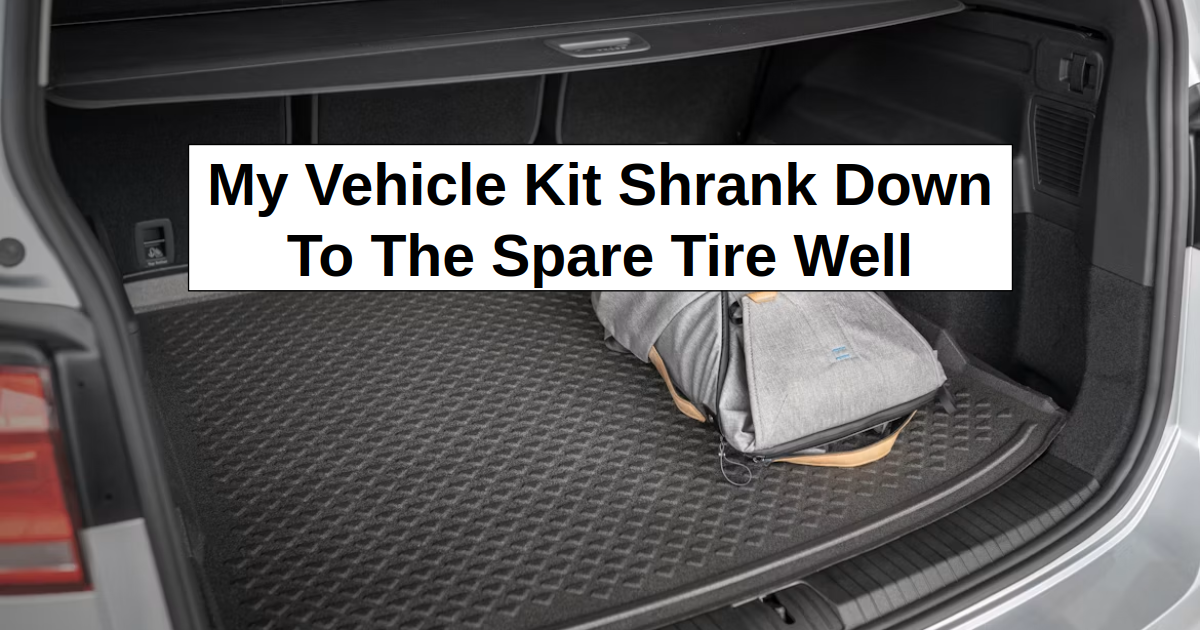
For years I kept both our vehicles stocked the way you’re supposed to with full get-home bags, tools, extra water, vehicle fluids … the works. I think my wife and I fought over trunk space once or twice. 😉
These days most of my wife’s trunk space is taken up by supplies for her job, so our bug out bags live inside the house now. What’s left in the vehicle is mostly whatever fits in the spare tire well, items like a tire inflator, jumper cables, a portable charger, and a sleeping bag. Aside from extra fuses, her get home bag, which includes an assortment of supplies, and a few odds and ends, that’s it. And after thinking it over, I’m not sure that’s actually a bad baseline for most people. Oh, and I keep a fire extinguisher and basic first aid kit, too.
Those items stuffed inside the spare tire well cover the most common roadside problems (a flat tire and a dead battery) plus a way to keep your phone charged if you need to call for help and, heaven-forbid, the phone and car batteries are completely dead. Everything else people, including me, load into a trunk kit is either duplicating what’s already in a get-home bag or highly unlikely to be needed, like fluids, and if it is, then just call a tow truck.
Placement matters as much as what’s in the kit. For instance, a fire extinguisher and a glass breaker do you no good buried inside a bag in the trunk. Those belong within arm’s reach of the driver’s seat; some people even clip the glass breaker/seat belt cutter to their seat belt. I keep our fire extinguisher under the driver’s seat.
What About for Bug Out?
The advice above assumes that you’re only concerned about getting home. But what if you had to evacuate?
That changes the equation drastically. Here, you might need a lot of items intended for self-rescue, such as: a towing kit, spare tires, extra fuel, fix-a-flat, and even vehicle fluids, not to mention hand tools and much more, assuming you have the ability to fix things on the go.
But as I’ve stated elsewhere, and certainly in my book on bugging-out, there’s only so much room. Add in people and animals, bug-out bags, and memorabilia my wife is more likely to priortize over me, and you’re running out of room very quickly. Worse, we currently only rely on a passenger sedan, so we’re not working with much room to start with these days. Ugh.
If I Were Starting Over
If I were rebuilding a kit from scratch, I’d start with the tire inflator and jumper cables I already keep, then add a portable power bank so you’re not depending on someone else’s car to get a jumpstart. This is essentially what I’m doing now.
A very basic toolkit (slip wrenches, screwdrivers, etc.) and duct tape for expedient repairs are helpful additions without turning the trunk into a hardware store. If you want the fuller list of what belongs in a proper kit, I posted about it a while back here: what to put inside a vehicle survival kit. And if a first aid kit isn’t part of your setup yet, that’s always good to include.
If there’s room, then add a get home bag or bug out bag or something like that, which includes personal supplies, some food and water, and whatnot. It doesn’t have to be extensive, but these items can be difficult to come by during an emergency. If you must, stuff items like bottles of water as well as extra socks and a stocking cap, under the seats or inside doorpad pockets. I used to do that and it worked out just fine.
I know a spare tire well stuffed with the basics isn’t an ideal setup. A change in our situation took over the trunk space, and the bug-out bags moved inside the house along with the removal of other items that I used to believe were needed. But I’m doing what I can, and I’d rather have something in a less than ideal spot than a fully loaded kit that never gets used because there’s no room left to close the trunk.
What’s actually in your vehicle right now? Is it the kit you’d build if you started over today, or is it what’s left after everything else took over the space, like with our vehicle?
Leave a Reply