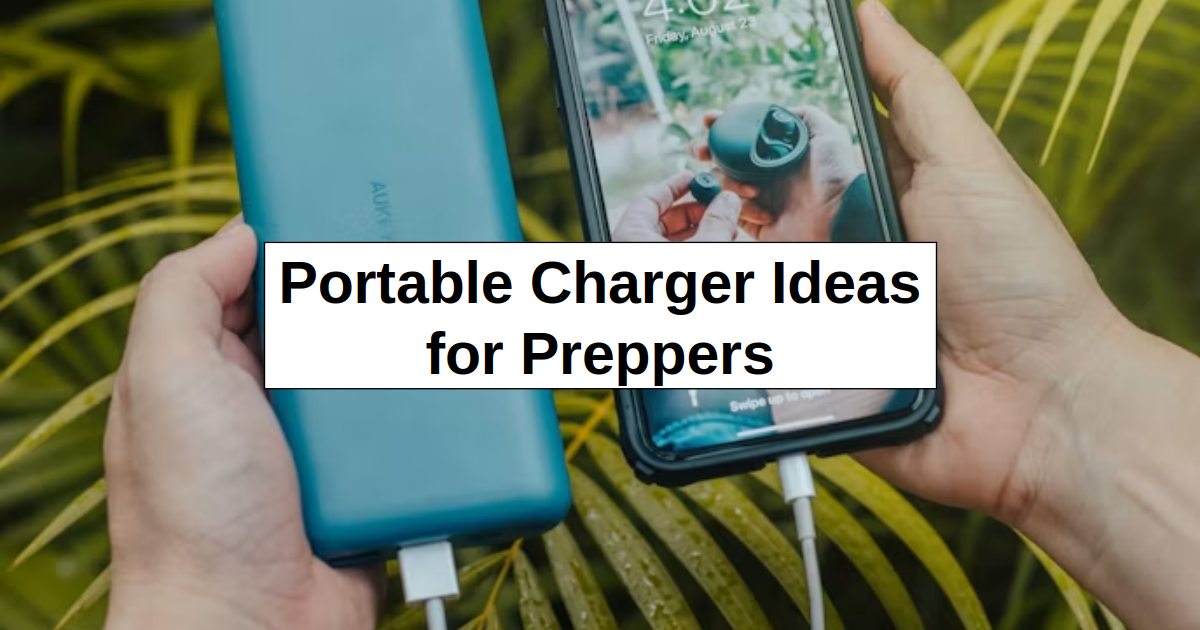
I’ve got several portable chargers, half of which I couldn’t tell you the exact capacity of without looking at the label. But I’ve got big ones and small ones if that helps. 🙂 And I’ve got them stashed in our bug out bags, vehicles, and elsewhere. Anyway, it’s been years since I bought anything new, so I started looking at what’s changed and whether my current gear still makes sense.
The short answer: 10,000mAh is really the floor now. That’ll get you about two or three phone charges depending on your phone, which sounds fine until you’re two days into a power outage and realize you may also need to charge a flashlight, a radio, and whatever else because you didn’t buy battery-powered gear like I recommend.
Most preppers land on 20,000mAh instead, and the good news is that capacity still fits in a pocket, albeit it on the heavy side. But if you just want something minimal for a day hike or around town use, the small 5,000mAh banks still have a place, they just top out at around one full charge.
Ports matter more than people think. A built-in cable is convenient until that one port/cable fails and the whole bank is basically dead weight. I’d rather have two USB-C ports, so a single failure doesn’t take out my only charging option, but this depends on your preference. Honestly, I’m liking that some chargers have built-in cords because they’re easy to forget or misplace.
Beyond that, a lot of people are standardizing their cords across every device they own just to simplify what they’re carrying, which isn’t a bad idea. But if we’re being honest, that would be difficult to do because your ports (e.g., USB-C, iPhone, mini, etc.) are subect to the whims of the manufacturer, and they change their cords almost every year.
A feature that gets overlooked, and is something I hadn’t considered until recently, is passthrough charging, where the bank can power a device while it’s plugged in and charging itself. That turns it into a small UPS during an intermitent outage; it’s worth considering even though it’s not common.
Size-wise, most decent banks stay pocket or shirt-pocket sized even at 20,000mAh. But, like I said, they tend to be too heavy for EDC carry. Jump-start packs that double as phone chargers are another idea, and what I use for our vehicles. These certainly can’t be carried as EDC, and you wouldn’t want to. But they’re best kept in reserve for jump-starting your vehicle; add another small power bank that’s just for your phones to your vehicle, too.
If you want something slim, the phone cases that double as a charger are worth a look. They basically extend your phone’s battery capacity a bit, but also add weight if that’s a concern. I’ve never used one, but I believe my mother has in the past … not sure why she stopped.
On brands, Anker is a trusted name at $49 to $59 for a 20,000mAh unit, with slimmer 10,000mAh options too. Nitecore makes compact, durable banks. Goal Zero has a good reputation, but the price varies widely by capacity, $30 to $40 for something small, $150 or more once you’re at 25,000mAh. Walmart’s budget banks run $8 to $25 and are fine for light use. Fuel Rod is the one you’ll find at airport kiosks for $20, with swappable cells you can trade at the same machine, but I’d imagine those are overpriced for what you get.
The unlabeled or off-brand options are hit or miss, since the capacity numbers on those are basically fiction; I’ve written before about power banks that lie about their real capacity, so don’t take the mAh number on the box at face value. In fact, just cut the number in half to be safe.
A couple practical notes before you buy. If you’re flying, airlines cap power banks around 100Wh per battery (roughly 27,000-43,000mAh from what I gather, but it’s not clear either), so check that before you pack one in your carry-on. And if you purchase an all black model, they’re impossible to find in a bag at 2am. Add a bright color or a strip of tape to save you from hunting. Ask me how I know.
For what it’s worth, my oldest Anker portable charger is several years old, and the last time I used it, which was probably a year ago, it still charged fine. That’s the kind of reliability that I’m afraid many off brand models can’t offer. But, at price points of less than $20-30 for most, you can probably buy more than one off-brand option and not be too concerned. That said, if you’re purchasing one for serious needs, like in your bug out bag, get a reliable namebrand option.
What’s in your preps right now, and how old is it? Does it still work well or is it time to replace it? And, if so, what are your main considerations?
Leave a Reply