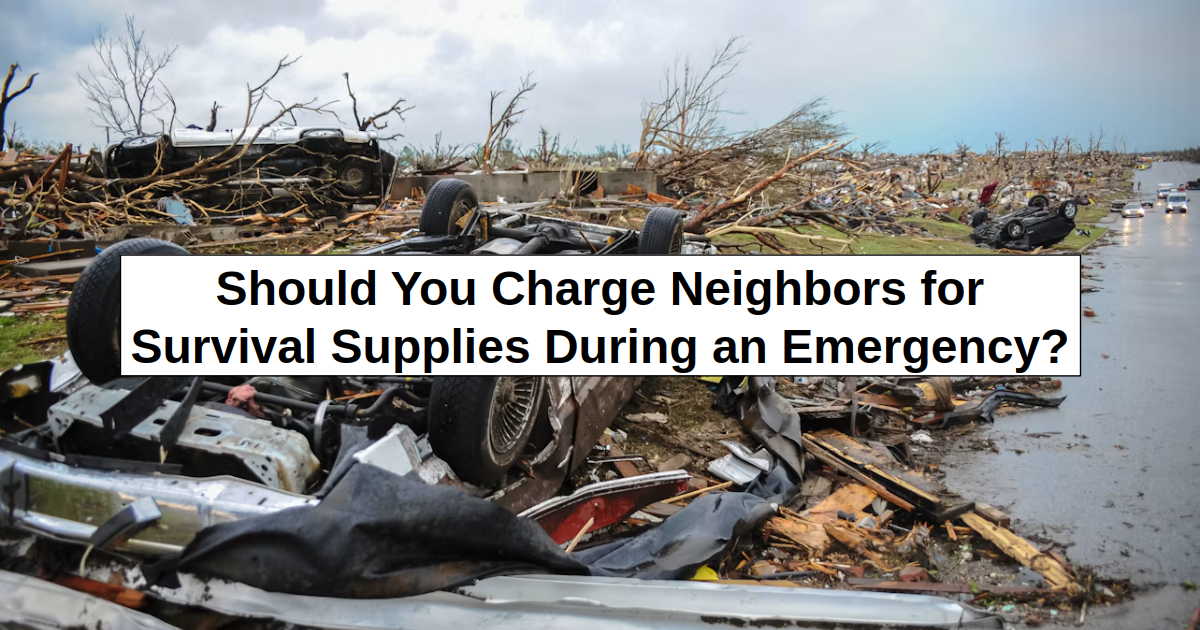
I recently read an interesting forum discussion about whether preppers should charge their neighbors for survival supplies during an emergency. The original question involved people who had spent their own money preparing, only to have unprepared neighbors show up wanting water, food, electricity, or other supplies when disaster struck.
Some people argued that charging for these supplies was fair, even if the prices were steep. After all, nobody forced those neighbors to ignore preparedness. Others thought charging desperate people outrageous prices was wrong, especially when their lives might depend on getting help.
And then there were those who wanted nothing to do with either approach. They figured the best option was to keep their supplies hidden and avoid becoming the neighborhood’s emergency supply store.
I can understand all three positions, although I think there’s more to consider than whether someone deserves help. For instance, what happens if you help one neighbor, but then five more show up? What if the emergency lasts longer than expected, and you end up needing the food or fuel you gave away? And what if people begin to see you as the person who has everything they need, but now you’re literally standing in their way?
That last concern bothers me more than whether someone pays a few dollars for generator power.
Is It Wrong to Charge for Survival Supplies?
Let’s start with the obvious: Preparedness costs money, sometimes a lot of it. Anyone who’s spent years building a reasonable stockpile knows how much time and money goes into it. Food storage, water containers, generators, fuel, solar panels, and all the other supplies we collect don’t magically appear in our homes.
We make choices about how to spend our money. Sometimes that means passing up something we’d rather buy because we believe having emergency supplies matters more. And we do it over and over again. I don’t think there’s anything wrong with expecting people to respect those choices.
Say you spent thousands of dollars installing a backup well pump and just as much buying a generator. Your neighbor, meanwhile, spent that money on vacations, a boat, or whatever else they wanted. When the power goes out, they suddenly expect you to provide water for their household.
Would it be unreasonable to ask them to contribute something in this case?
I don’t think so.
Running a generator takes fuel. Equipment needs maintenance. Even something as simple as filling water containers takes time and effort, especially if you have multiple neighbors coming around every day.
Asking someone to provide gasoline in exchange for pumping water seems reasonable. So does asking them to replace the fuel you’ve used or contribute something else of value. Of course, there’s a difference between recovering your costs and trying to make a fortune because someone else is desperate.
If your neighbor needs a few gallons of water for drinking and cooking, charging them some outrageous amount because you know they have no other choice seems wrong to me. You might have every right to protect your investment, but that doesn’t mean every price you demand is fair.
And depending on where you live, emergency price-gouging laws might apply to certain sales. Those laws vary by state and the circumstances, so don’t assume you can charge whatever you want just because. Besides, money isn’t necessarily the best payment during an emergency.
If stores are closed, roads are blocked, and there’s no telling when things will return to normal, what good does another twenty-dollar bill do you? Probably not much in the moment.
I’d rather have someone contribute what little bit of fuel they have for my generator, or better yet, useful skills and labor if I needed those things. Maybe they can help clear a fallen tree, watch the kids while you’re busy, or provide something your household unexpectedly lacks.
Even agreeing to replace supplies after the emergency ends might be reasonable enough, although I’d treat that promise as a bonus rather than something guaranteed. People forget what they owe pretty quick, and some aren’t as eager to repay a favor once they no longer need help.
Good Neighbors Can Be Worth More Than Money
One point that came up in the discussion was whether helping people for free might be worth more than charging them; I think there’s something to that.
Let’s say a storm knocks out power for several days. Your neighbor has a chainsaw, another has a truck, and someone else knows how to repair generators. You happen to have a working generator and some extra fuel.
Rather than everyone trying to manage on their own, it makes sense to cooperate. Maybe you let a neighbor charge their phone or keep some medicine refrigerated. In return, they help clear your driveway or bring over a few gallons of gasoline to keep things going.
Even if they have nothing useful to offer right now, that doesn’t mean they won’t be able to help later. And it doesn’t mean they’re lazy or irresponsible, either.
It’s easy to assume that people who haven’t prepared are careless, especially when we see them spending money on things we consider wasteful. But we don’t know everyone’s circumstances. Someone could be dealing with medical bills, a lost job, or other financial troubles.
I also think we need to make exceptions for people who genuinely can’t help themselves. If an elderly neighbor needs drinking water or a family has young children who are going without food, I’d have a hard time turning them away if I could help without putting my own household at risk.
That doesn’t mean I want to feed the entire neighborhood, either. There’s a limit to what any one family can do, and pretending otherwise isn’t helpful. Still, I wouldn’t want my neighbors to remember me as the guy who charged them an arm and a leg for a gallon of water during a weeklong outage.
Remember that emergencies do end. When life gets back to normal, you’re going to see those same people at the grocery store, at church, or walking down the street. Some might remember that you helped them when they needed it most, while others might remember that you took advantage of them.
Of course, there’s no guarantee that helping someone will earn you a lifelong friend or even any help when you need it. Clearly, some people will take whatever you’re willing to give and never think about returning the favor.
But I’d rather build decent relationships with my neighbors before an emergency than try to figure out who I can trust afterward or when I’m in need. That’s a form of preparedness most of us probably don’t spend enough time on. At a minimum, I suspect I’d be doing right in God’s eyes.
The OPSEC Problem Nobody Should Ignore
As much as I believe in being a good neighbor, there’s another concern that could make the entire debate about charging irrelevant: Operational security, or OPSEC.
I’ve discussed OPSEC before, including in my articles Don’t Follow My Lead, Get Your OPSEC in Order Now! and Don’t Mow the Lawn and Other OPSEC No-Nos.
The basic idea is that you shouldn’t make it easy for other people to figure out what supplies you have or what you’re capable of doing during an emergency. Surely providing supplies to neighbors, whether you charge or not, violates OPSEC.
Imagine a widespread power outage where most households have no electricity. You’ve got a generator running, and a neighbor asks if they can charge their phone or whatever.
No big deal, right?
You let them plug it in for an hour, and they leave happy. Later that afternoon, another neighbor shows up because they heard you had electricity. The next day, several more people want to charge phones, keep their food cold, or run medical equipment.
Before long, you’ve become the neighborhood charging station.
Maybe you don’t mind helping at first, but your generator burns fuel every hour it runs. Eventually, you might have to decide between keeping your own freezer cold and helping someone else.
Worse, everyone now knows you have backup power. They might start wondering what other emergency supplies you’ve stored, like food, water, fuel, or almost anything else that’s hard to get.
Once people know you have extra supplies, they might tell their friends and family if they can communicate. Those people tell others, and suddenly you’re dealing with real strangers who assume you have plenty to spare.
Charging people doesn’t necessarily solve the problem, either. In fact, it could make things worse because you’re openly advertising that you have something valuable enough to sell and plenty of it! And if you charge outrageous prices, you might create resentment among strangers who know where you live.
Of course, there’s no guarantee that anyone would become violent or try to steal from you. Most people aren’t looking to rob their neighbors outright. But I wouldn’t want to give desperate strangers a reason to focus on my house now or after an emergency has passed. That’s why I believe there’s a lot to be said for keeping most of your preparedness efforts private.
You can still be friendly with neighbors, help where you can, and get to know people without telling them about your food storage, generator, or other supplies.
So, if you decide to help during an emergency, be careful about how much you reveal. For example, you might offer someone a few gallons of water without explaining that you’ve stored hundreds more. Or you could let a trusted neighbor charge a phone or a mini fridge without inviting everyone into your garage to inspect your backup power.
Thus, it’s worth considering precisely how you will help, and in what circumstances, before a disaster strikes. And it’s equally important how you will retain your OPSEC in such circumstances.
How Much Help Is Too Much?
I think the type and length of emergency matter more than anything else. During a short power outage after a thunderstorm, I’m going to be more willing to share supplies than I would during a prolonged disaster where nobody knows when things will improve. This is obvious.
If I have plenty of stored water and expect the city supply to return tomorrow, giving a neighbor a few gallons isn’t a big deal. But if the water system is expected to be down for weeks, and there’s no clear plan to restore it, I’d be much more careful about what I give away.
The problem is that we rarely know how long an emergency will last while we’re living through it. What seems like a minor outage now could still be causing trouble the following weekend.
That’s why I think you need to establish limits before people start asking for help. Maybe you’re willing to provide drinking water to a few trusted neighbors, but only in amounts you can spare. Perhaps you’ll let someone use your generator for an urgent need, but not for hours to charge their phones so they can scroll social media or play games. Think about this now.
Remember that you don’t need to demand payment or expect something later for every favor, either. Sometimes helping someone is the right thing to do, and that’s enough. Other times, asking people to contribute something makes sense because the costs are adding up. There’s nothing wrong with setting boundaries, even if you’ve already helped someone.
In fact, I think one of the worst things you could do is offer unlimited help at the start of an emergency, only to discover you’ve given away too much. It’s easier to explain your limits up front than disappoint people who’ve come to depend on you.
And if you decide not to share certain supplies at all, that’s your choice. Nobody outside your household knows exactly what you’ve stored, how long it needs to last, or what problems you’re dealing with or expect to deal with.
I wouldn’t refuse to help someone merely because they hadn’t prepared as well as I thought they should. But I wouldn’t put my own family’s safety at risk to make up for someone else’s lack of planning, either. Unfortunately, there’s no simple way to know where that line belongs until you’re faced with a real situation.
For me, the best approach would be to help trusted neighbors where I reasonably could, encourage fair exchanges when appropriate, and avoid revealing more about my preparations than necessary. I’d also prefer to work with neighbors who are willing to contribute to a shared solution rather than become dependent on one household for everything.
Of course, that’s easier to say when the lights are on, grocery stores are open, and nobody’s standing at your door asking for another glass of drinking water.
Maybe the most useful thing we can do right now is get to know our neighbors better while encouraging them to build their own emergency supplies. That way, there will be fewer people needing help when something goes wrong.
I’m curious what you would do. Would you charge neighbors for survival supplies during an emergency, help them for free, or keep your supplies private and avoid getting involved?
Leave a Reply