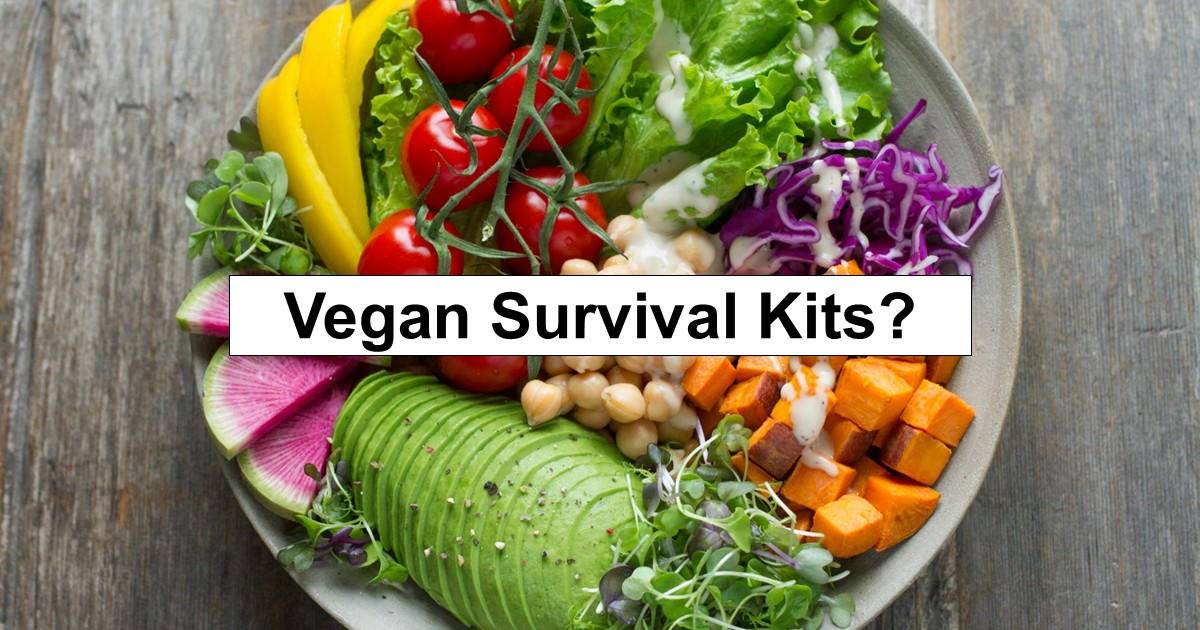
I get daily Google Alerts about stuff related to preparedness, like articles on survival food and natural disasters, or even home security. I usually quickly glance through the alerts and move on, since most links are re-hashed and boring survival posts or probably trying to sell you something. Honestly, this post on vegan emergency kits appears similar, in that, they offer several products recommendations, but the title got my attention nonetheless.
Now, I’m not a vegan or vegetarian. But I’m not a “I must eat meat” three meals a day kind of person either. I also recognize that most people have very strong feelings about why people should eat a certain way. Honestly, I don’t much care what people do in their own lives. I only really care about other people telling me how I must eat or live my life for one reason or another, especially people I don’t know.
No doubt, the person telling me how I must eat most of the time is my wife and, like it or not, she’s usually correct. (So, you’re not supposed to have cookies with breakfast? I beg to differ.)
Anyway, I have become more interested / tolerant about dietary needs since I’m encountering more people who have problems with food, including family members. Some of those folks restrict certain foods out of preference; others out of necessity. Regardless, I know family members who are vegetarian (no meat), vegan (no meat or dairy), pescetarian (only eat fish, no other meat), and one person who can’t eat grains, dairy, and an assortment of other foods. Truth be told, I have no idea what she can eat at this point!
Thankfully, my immediate family (those in the household) can eat most any food, though there are preferences. But what about those who can’t eat anything? What might they stock in their pantries for an emergency?
Well, it seems most people that choose to restrict their diets in my family do so out of preference. So, they probably could eat other food, they just choose not to. That said, there’s no harm in them attempting to respect their preferences if it’s reasonably achievable. With this in mind, let’s consider what a vegan might be able to do.
Because vegan diets specifically avoid all animal products, which include meat, dairy and eggs, that removes a large portion of “traditional” food from their diet. But it’s not just “extra food” that’s missing because there are crucial nutrients that are inevitably lacking.
A brief internet search says that: “A vegan diet requires careful planning to avoid deficiencies in several key nutrients, primarily vitamin B12, iron, calcium, vitamin D, iodine, zinc, and omega-3 fatty acids, which can lead to health issues such as anemia, osteoporosis, and neurological disorders.”
But one of the first concerns non-vegans have is that there’s not enough protein in the diet, which for some reason, wasn’t initially listed in the above needs when I searched. Hmmm. The brief internet search, however, later states that: “Protein intake is generally not a concern if a variety of plant proteins are consumed, but ensuring all essential amino acids are included is important.”
Apparently, the problem is less about missing amino acids and more about them lacking in appropriate quantities. Specifically, Lysine, Methionine, and Leucine are the biggest missing pieces. But because I know you can get Lysine supplements, and I assume you can get the others, I would probably start with the simplest solution: supplementation.
Just looking at the biggest concerns from the list above, which include vitamin B12, iron, calcium, vitamin D, iodine, zinc, and omega-3 fatty acids, it’s clear that a variety of supplementation is the easiest answer. But, then, I doubt a multivitamin would cove all of their needs.
That said, I think a bigger long-term problem, assuming a person doesn’t want to take several supplements or is worried about their efficacy down the road, would be getting enough plant-based food directly from food storage. Because vegans likely get more nutrients than non-vegans from “healthier” grains like brown rice, quinoa, assorted legumes, and probably soy-based food (which I think is gross and not that healthy) several of the recommendations from my food storage book would need to be amended significantly because my assumption is that the reader can (and will) eat most any common food.
Ultimately, I’d say a vegan-based diet is possible with food storage, but a person would have to think long and hard about the specific foods they choose to store and how.
The good news is that there are shelf-stable options, such as soy-based products, and many “healthier” grains will last a year or longer so long as they’re rotated, but I don’t see a vegan being able to store most of the foods they need for years without worry. But, then again, I don’t know enough about the diet to know what’s really available in shelf-stable form. Even so, there are several freeze-dried, vegan-friendly meals mentioned in the vegan emergency kit article that got me thinking about this topic, so I’d imagine there are more options than I’m currently aware of.
So, maybe it’s not as bad as I’d initially assumed to be a vegan prepper. But like anybody who needs/wants a very specific diet, these foods may be the most difficult to acquire during and after a SHTF event. Thus, if you require a specialized diet, be sure to add plenty of what you need now, while they’re still available and relatively affordable, because they may be like gold when your stomach grumbles.
Leave a Reply to GregE Cancel reply