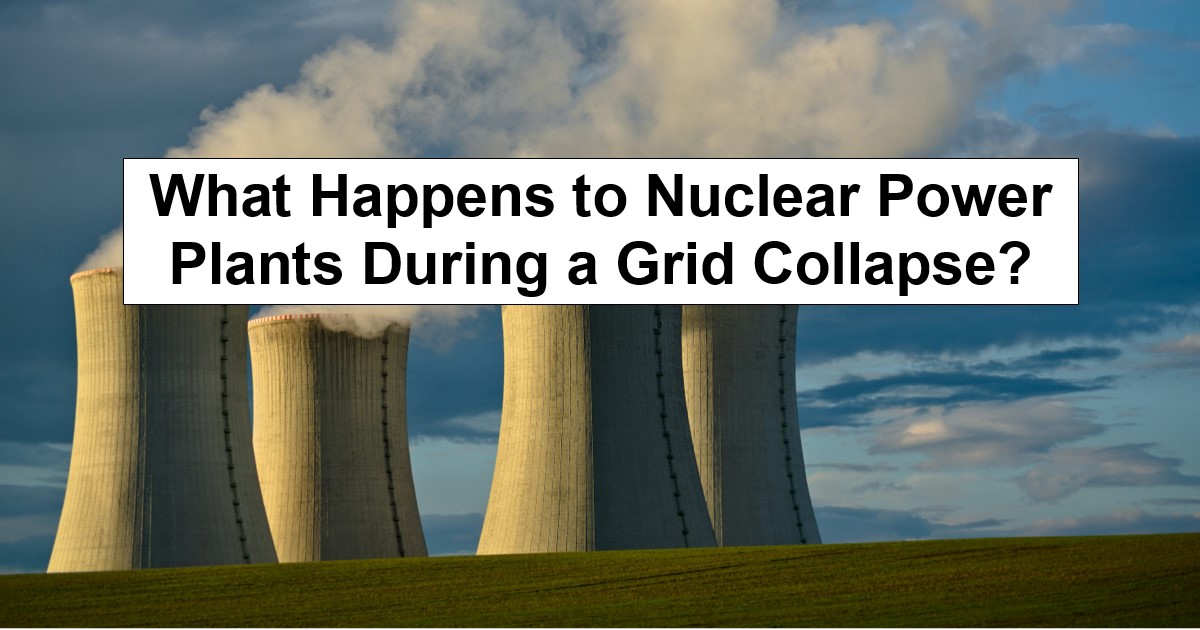
We’ve all seen the movies where the power goes out, the world descends into chaos, and then, inevitably, every nuclear power plant on the horizon starts blowing up like a slow-motion fireworks display. It’s a terrifying image, and frankly, it’s one that has kept more than a few preppers up at night … me included. But I wondered how much of that was Hollywood fiction and how much is a realistic threat we need to account for in our planning?
I’ll be the first to tell you that I am not a nuclear engineer. I don’t have a degree in physics, and I certainly don’t know the intricate details of every valve and sensor inside a reactor core. What I am is someone who has spent over fifteen years looking at the patterns of how things break—specifically our power grid—and trying to figure out what that means for me and my family. I’ve done a lot of digging into what experts believe might happen when the lights go out for good, and the reality is a bit more nuanced (and in some ways, more urgent) than the movies suggest.
Clearly, we need to understand that nuclear power plants aren’t just “on” or “off.” They are complex systems that require a constant, stable connection to the very grid they help power. It’s a bit of a paradox, isn’t it? The moment that grid connection fails—whether it’s a localized transformer failure or a nationwide collapse of the grid—the nuclear power plants immediately enter a state of emergency.
Their Response When Things Go Bad
When everything goes horribly wrong in a nuclear power plant, the operators perform a “SCRAM.” This is basically an emergency shutdown where control rods are rapidly inserted into the reactor core to stop the nuclear chain reaction. In most U.S. plants, this happens in about three seconds. You might think that once the fission stops, the danger is over, but that’s not quite how it works.
Even after the reactor is “off,” it still produces what’s called “decay heat.” Think of it like a massive cast-iron skillet you’ve just taken off a roaring flame … it’s not “cooking” anymore, but it’s still hot enough to burn your hand if you’re not careful. That heat has to be moved away, or the nuclear fuel will still eventually melt the containment chamber.
I recently watched this video, from Canada, that explains the scenario much better than I could here, showing how these various safety systems are designed to kick in when the worst happens:
Again, this is what Canada does, though I’m unsure how the United States plants may differ. But we’re not quite to the SCRAM option yet because, immediately after a grid failure, backup diesel generators are supposed to roar to life within seconds to keep those cooling pumps moving. (And there are emergency generators if those fail.) Most plants are required to keep at least seven days of fuel on site for these generators, which buys them a week to keep things going. During this time, the operators are essentially in a race against the clock to restore off-site power or find a way to keep the fuel coming in to power the generators.
Since the Fukushima disaster in 2011, the industry has also implemented what they call “FLEX” equipment. These are portable pumps and generators stored in reinforced buildings on-site that can be rolled out if the main systems fail. In a local or even a regional outage, help should eventually arrive from one of the national emergency response centers or other first responders (like the fire trucks the video above mentions several times), usually within 24 hours. But obviously, that assumes the rest of the country is still functioning well enough to send a truck or a helicopter or whatever the plan is.
My question: What if the rest of the country is experiencing the same problem?
A Solar Storm Wildcard
This brings us to a scenario I’ve been reflecting on lately: a massive solar storm like the one we dodged in 2024 and more recently. We’re talking about a Carrington-level event where a coronal mass ejection (CME) from the sun slams into Earth’s magnetic field and causes havoc worldwide.
In a normal grid-down scenario, we assume the backup generators will save us or maybe the fire department. But a severe solar storm generates geomagnetically induced currents that can fry high-voltage transformers across the entire continent! The concern here is that these same currents can potentially damage the very safety systems we rely on, or at the very least, ensure that the grid stays down for months or years because the specialized transformers take forever to replace, which means those nuclear power plants will never operate again.
If a solar storm is powerful enough, it might trigger an automatic reactor shutdown to protect the plant’s own internal systems. But if the storm also disables the backup generators or the electronic controls for those FLEX pumps mentioned earlier, we move from a “manageable crisis” to something much worse. It’s one of the reasons I’ve expressed my problems with nuclear survival in the past; we are essentially betting our lives on the idea that these safety nets will always function.
Ultimately, a solar storm could be both the cause of a massive grid collapse and the reason why nuclear power plants meltdown. But, again, I’m only speculating.
The National Collapse
Now, let’s look at a nationwide grid collapse where help isn’t coming within that critical week time frame. Maybe it’s a coordinated cyberattack, or world war 3, or maybe it’s just the total economic instability I’ve been warning about for years finally reaching the breaking point.
Once those seven days of diesel fuel run out, and if no more can be scavenged or delivered, the situation gets bad. Without active cooling, the water in the reactor core will eventually boil away, leading to a core melt. But, perhaps surprisingly, the bigger concern for many experts is the spent fuel pools.
These pools are where the “old” fuel is kept for several years until it’s cool enough to be moved into dry storage. Yes, I said several YEARS. They are often densely packed and require constant water circulation to stay cool. If the power goes out and the pumps stop, that water starts to evaporate. Guess what happens after that?
Nothing good.
Experts suggest that after about four days without cooling, the water level could drop enough to uncover the fuel. If that happens, the zirconium cladding on the fuel rods can actually ignite. We’re talking about a fire that could release massive amounts of radiation (potentially far more than the Chernobyl accident) because these pools hold so much more radioactive material than what’s actually in the reactor core.
FYI, I found this conversation about the risks of these pools particularly eye-opening. What I found absolutely terrifying was how many ways things could go horribly wrong just with the fuel pools alone, including terrorism, earthquakes, and believe it or not, moving the rods into dry caskets. I recommend watching this:
From what I gather, in a total national grid collapse, we are looking at a timeline where the most critical window is between 12 and 31 days. That is when the risk of a fire from spent fuel rods is at its highest if cooling isn’t restored. (After that, I assume it just becomes a less disastrous local catastrophe? I don’t know!)
Is Widespread Meltdown Possible?
The question, of course, is whether we’ll see a widespread “meltdown” where dozens of plants fail at once? For what it’s worth, there are currently 54 operating plants in the States (here’s a map), most east of the Mississippi river.
If you ask the industry, they’ll point to the layers of redundancy and the fact that modern containment buildings are designed to hold in almost all radioactivity even if a meltdown occurs. And to be fair, a reactor melting through its vessel doesn’t necessarily mean a massive atmospheric release if the containment structure holds.
However, some safety analysts argue that in a prolonged, society-wide collapse, the sheer number of plants needing attention would overwhelm any remaining emergency response. And if the grid is down for weeks or months, the risk of multiple nuclear disasters unfolding becomes a very real possibility.
Final Thoughts
So, where does that leave us? Clearly, we can’t fix the grid ourselves, and we certainly can’t go down to the local nuclear plant and offer to help refuel their generators. But we can prepare for the localized fallout of these events.
A critical part of dealing with potential nuclear issues is being able to actually see the “invisible” threat, which means having a reliable way to measure radiation levels in your immediate environment. While you don’t necessarily need a lab-grade setup, having a portable Geiger counter can provide the peace of certainty when rumors start flying.
I’ve looked at a few options, and for most of us, a versatile handheld detector that can measure Alpha, Beta, Gamma, and X-ray radiation is the way to go. A popular entry-level choice is the GMC-300E Plus, which is straightforward and won’t break the bank, or if you want something a bit more rugged and professional, the GQ GMC-500 Plus offers dual tubes for higher range detection. (To be clear, I have yet to purchase either option.)
Obviously, these aren’t toys, and you should take the time to learn how to read them before you actually need to use them. Just remember that having the tool is only half the battle; knowing what the numbers mean for your safety is what actually keeps you alive.
Additionally:
- Distance is your friend. If you live within 50-100 miles of a plant, especially downwind, you should have a clear evacuation plan to get away from the danger.
- Stockpile the basics. If there is a radioactive release, and you weren’t able to evacuate, you’ll surely want to “shelter in place” for several days to two weeks to let the most volatile isotopes decay. This is where having something like a DIY nuclear fallout shelter bucket becomes a practical, common-sense move. But even that is a minimal investment; you’re going to want much more if you must stay indoors for weeks.
- Focus on what you can control. We can’t prevent a solar storm or a grid collapse, but we can ensure our own families have the food, water, and protection they need to survive the first few weeks when things are at their most chaotic.
The reality of nuclear plants in a grid-down world is a race against time. The backup systems are designed to buy us days to respond, but they aren’t built to counter a truly lengthy blackout. Treat them as a serious, long-term risk factor in your planning, but don’t let the fear of them paralyze you, either. The most important thing is to have your own house in order before the lights go out just in case the worst happens.
What do you think? What am I missing?
Like I said, I don’t know much about nuclear power or nuclear safety, so maybe I’m off base. And I know that it’s easy to dive down the rabbit hole of fear-mongering, so if this is an entirely unrealistic view of the problem, tell me!
Leave a Reply