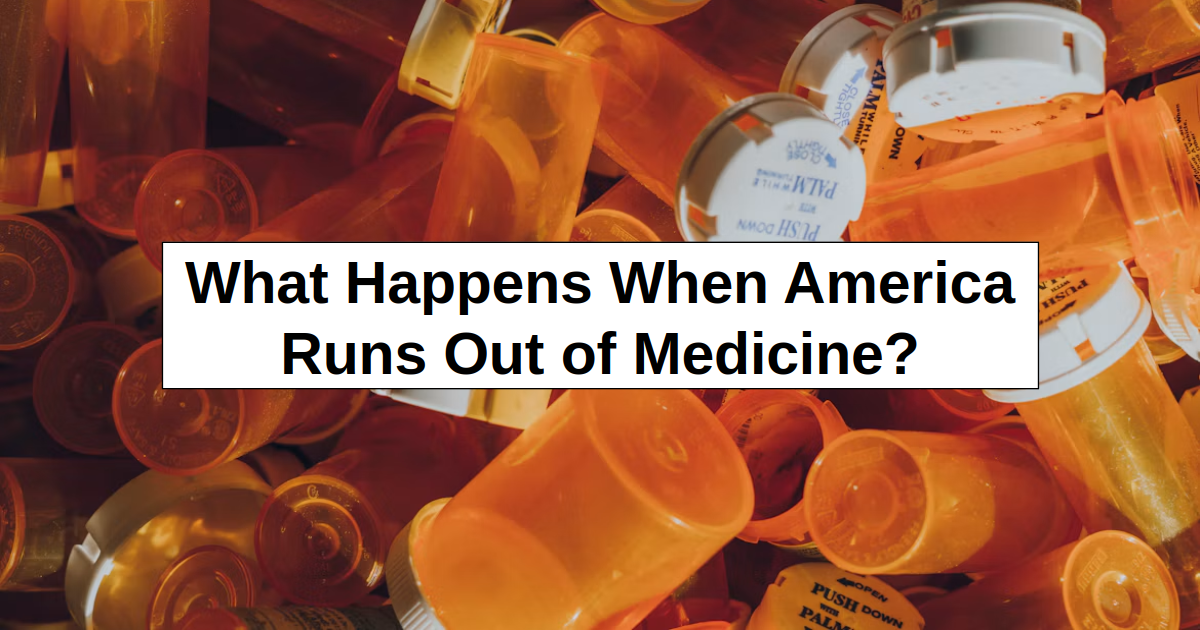
Suppose your local pharmacy tells you it can’t refill your prescription. You try another pharmacy, but they’re out too. Then another; same thing. Turns out the problem isn’t a temporary shortage of one medication … deliveries have stopped because of a nationwide transportation or supply breakdown, and nobody knows when they’ll resume.
For someone who needs blood pressure medication, that’s concerning. For someone who depends on insulin to survive, it’s potentially deadly. And for everyone else, you and I included, it can be anything from simply annoying to deadly, too.
We’ve become accustomed to medications being available whenever we need them, barring the occasional hiccup. But what happens when pharmacies, hospitals, and medical warehouses exhaust their existing supplies to the point where the stuff we need just isn’t found no matter the price? What happens when millions of Americans need medications that nobody can provide?
And I’m not talking about a weeklong disruption. I’m talking about a nationwide crisis that lasts months, perhaps longer. It’s a hypothetical scenario, but one worth considering because our pharmaceutical supply chain has some serious weaknesses.
America Depends Heavily on Foreign Medications
According to the FDA, approximately 73% of registered manufacturing facilities for active pharmaceutical ingredients were located outside the United States in 2025. The same report indicated that 52% of registered finished drug manufacturing facilities were overseas. That’s a concerning amount of our medicine production taking place elsewhere!
The U.S. Pharmacopeia, which tracks pharmaceutical manufacturing, found that only about 12% of the active pharmaceutical ingredient volume used in U.S. prescription drugs was produced domestically in 2024. Active pharmaceutical ingredients are the parts of medications that produce their intended effects. Even when a drug is manufactured or packaged in America, some of its ingredients might come from another country.
Anyway, these figures measure different things, but they point to the same problem: America relies heavily on foreign drug production, particularly from India, China, and Europe.
Under normal circumstances, this system works great. Manufacturers produce drugs, ships and planes transport them, distributors send them to pharmacies and hospitals, and people receive their prescriptions or whatever it is they need.
But consider what happens during a prolonged international conflict, another global pandemic, or maybe a nationwide transportation breakdown or strike. Even if American factories remain operational, they might lack the ingredients, packaging, or other supplies needed to keep producing medications.
And if transportation stops working, it doesn’t matter how much medicine exists in a warehouse somewhere. It still has to reach the consumer, which could easily be across the country.
What Happens When the Remaining Medicine Runs Out?
The first thing to understand is that medications wouldn’t disappear everywhere at once. That’s just not how things work, though some pharmacies would exhaust their supplies sooner than others. Hospitals might have larger reserves of certain drugs and almost nothing of others. Folks with longer-term or recently filled prescription could continue taking their medications for weeks or months.
Initially, pharmacists and doctors would do what they already do during shortages. They’d search for alternative suppliers, substitute medications when appropriate, and work with patients to adjust treatment plans. Hospitals would likely begin conserving medications, postponing procedures that aren’t urgent, and reserving scarce drugs for patients with the greatest medical need. We’ve seen smaller versions of this problem before.
During the COVID-19 pandemic, hospitals experienced shortages of certain drugs and medical supplies. Manufacturing problems have also caused shortages of antibiotics, cancer drugs, and injectable medications in recent years. The FDA even maintains a database of ongoing drug shortages. Manufacturing quality problems, production delays, and shortages of raw ingredients are among the common causes.
But those situations occurred while most of the pharmaceutical supply chain remained functional. In our hypothetical scenario, the entire system is struggling at best. There’s no nearby distributor with another shipment coming, and hospitals can’t count on neighboring facilities having anything to spare because they’re not getting shipments either.
Now, the federal government maintains the Strategic National Stockpile, which includes medications and other medical supplies for public health emergencies. However, it’s intended to provide emergency support, not replace the nation’s entire pharmaceutical distribution system indefinitely. Thus, it wouldn’t be reasonable to expect the stockpile to provide every American with their usual prescriptions for months or longer. And I’m sure they don’t stock every last pharmaceutical that people need.
What Happens to People Who Depend on Medication?
This is where the scenario becomes particularly troubling. A few examples…
Consider people with type 1 diabetes. Without insulin, their bodies can’t properly control blood sugar. They can develop diabetic ketoacidosis, a potentially fatal condition that requires emergency treatment. Like it nor not, a person who depends on insulin can’t replace it with an herbal remedy or simply eat fewer carbohydrates and expect to survive. That’s just not how it works.
People with epilepsy face another danger. Missing medications can trigger seizures, including prolonged seizures that can cause lasting injury or death.
Heart medications present different problems. Some people depend on drugs to control dangerous heart rhythms, prevent blood clots, or manage heart failure. Interrupting those treatments can increase the risk of strokes, heart attacks, and even death.
Psychiatric medications are another concern. Suddenly stopping certain antidepressants can cause severe withdrawal symptoms. Abruptly stopping some sedatives can even trigger life-threatening seizures. For other patients, the return of untreated mental illness could make daily life increasingly difficult, to say the least. Numbers put it at nearly 20% of U.S. adults as having reported taking prescription medications for their mental health. Granted, not everyone is going to “lose it” when they go off their meds, but it won’t be pretty.
And then there are antibiotics.
We tend to take antibiotics for granted because they’re readily available. But without them, common bacterial infections could become much more dangerous. An infected wound, pneumonia, or urinary tract infection could easily progress into a life-threatening illness. And we often only think about pills, but I got an ear infection about a month ago and needed antibiotic ear drops; maybe the problem would’ve fixed itself, but I was grateful for an easy solution.
Older Americans would be especially vulnerable because many manage several chronic conditions at once. Losing access to even one medication could cause problems, while losing several could be disastrous.
Obviously, the consequences wouldn’t occur on the same schedule or rise to the same severity for everyone. Some patients would experience medical emergencies soon after their medicine ran out. Others might survive for months before their untreated conditions became serious.
Unfortunately, the longer the shortage continued, the more people would become worse. Hospitals would face growing numbers of patients while having fewer medications available to treat them. That’s a recipe for a worsening disaster. And that’s assuming doctors offices and hospitals could remain open, with enough electricity, water, staff, and equipment to even function.
It’s difficult to see how that situation could continue for months without causing many preventable deaths.
Can You Prepare for Something Like This?
I’ve discussed the problem of medication dependence in my earlier article, Medications Are a Huge Vulnerability, Even for Preppers. The basic advice remains the same. Work with your doctor and pharmacist to build an emergency supply wherever possible, so if something were to happen, that you’re not instantly in trouble.
For some prescriptions, a 90-day supply might be available. Depending on your insurance plan and state rules, emergency refills or other arrangements might also be possible.
Of course, having extra prescriptions isn’t the whole solution. Medications expire, treatment needs change, and some drugs require refrigeration or other special storage conditions.
It’s worth asking your doctor which medications would be most dangerous to interrupt, whether safe alternatives exist, and what you should do if your usual medication becomes unavailable. Never assume that skipping doses, splitting pills, or replacing one drug with another is safe without actual medical guidance … and, no, a brief internet search may not be the best resource when your life depends on an educated answer.
At the very least, keep an updated list of prescriptions, doses, and medical conditions with your emergency paperwork. Rotate any extra medications properly, and account for refrigeration needs if the power goes out. Those steps can help you survive a temporary disruption. They might even buy you several weeks or longer, depending on your prescriptions and how much you’re legally able to keep on hand.
But what about a crisis that lasts many months or more?
That’s where personal preparedness reaches its limits. You might have enough food stored, a reliable water source, and ways to heat your home. Yet none of those things will replace insulin or medication needed to prevent life-threatening seizures.
And even someone who doesn’t take prescriptions could develop an infection or suffer an injury that requires drugs which are no longer available.
I don’t believe a complete nationwide pharmaceutical collapse is likely under most circumstances, though temporary shortage or regional disruption is far more plausible. Still, the dependence on overseas production and a functioning transportation system makes this a weakness that deserves some attention.
The uncomfortable truth is that modern medicine allows millions of people to live longer, healthier lives with conditions that were once far more dangerous. But that benefit depends on a steady supply of medications and a society that continues to function. If that supply disappears for long enough, many of those medical gains disappear with it.
So I’ll leave you with a question: If your prescriptions became unavailable tomorrow, how long could you manage before your health was seriously at risk? What would you do instead?
Leave a Reply