I’m sure you’ve heard the phrase: “two is one, one is none.” It sounds like a throwaway line until you actually start looking at what people say they own multiples of. The answers get specific fast, and they go a lot further than a spare flashlight in the closet.
You see, preppers aren’t just keeping a backup can opener in a drawer and calling it a day. They’re running redundant power systems, doubled-up medical kits, spare vehicles, and enough tools to outfit a small shop. Some of it makes total sense; other ideas start to look like an excuse to buy more gear. But I’m sure both things can be true at the same time, at least, that’s what I tell my wife, lol.
There’s also a real argument for not doubling up on everything. If something’s cheap and easy to replace, a spare doesn’t add much value. You could, instead, save the redundancy for equipment that’s expensive, hard to fabricate, or critical enough that losing it creates a real problem.
Let’s talk about those items.
Power and Energy
This is where redundancy shows up in a big way because it’s so important. People running off-grid setups often have more than one solar generator, more than one set of panels, and battery banks stacked on top of battery banks. Add in propane heaters, wood stoves, and traditional generators, and you start to see why power/energy tops most people’s lists of crucial “just in case” gear. But I recognize that power is among the most expensive prepping items, so just having a primary off-grid option is the best most of us can do.
Connectivity counts too. More people are running satellite internet as a backup, especially if they live somewhere with spotty cell service. Remember that connectivity isn’t just about streaming the latest television shows or watching cat videos, because if you work from home or need to reach someone during a grid-down situation, a reliable backup connection matters more than most gear.
Smart preppers take it further and run low-wattage versions of many home appliance specifically to stretch a generator’s runtime during an outage. That’s a wise move even if you’ve already got the redundancy in place because it could mean the difference between running a generator for six hours or twelve and, therefore, running out of gas on day 3 or day 6. Math matters.
Tools
Tools split people into two camps. One side swears by multi-tools because they’re compact and versatile. I loved carrying my Leatherman, but I rarely do anymore because I’m at home most of the day and I don’t want to lug it around when I’m not.
The other side thinks multi-tools fail exactly when you need them most, and prefers dedicated tools instead, such as a real fixed blade knife instead of a folding one, or a proper saw instead of an afterthought added to the aforementioned multi-tool.
I lean toward the second camp, honestly. A multi-tool is fine for “nice to have” use, but it’s not what I’d reach for if something actually needed dealt with under pressure. My advice: own real tools for real problems!
A lot of people scatter basic tools (a set of common sockets, a couple of screwdrivers, some pliers) around the house and vehicles so one’s always within reach. But you don’t want to be searching the garage for whatever you need if you had to evacuate in a hurry, either. And then there’s always the possibility that the very same tools you expected to rely upon after a disaster are now buried under a pile of rubble. (I literally created a toolbox for preparedness purposes for this very reason.) Ultimately, it’s hard to get much done without the right tool.
Vehicle Redundancy
Spare vehicles are for practical reasons beyond just having a backup ride in case the first one has problems. People who live places with real winters often keep two plow-equipped trucks or snowblowers, because losing snow removal capability can become a real threat to their very survival. People near water sometimes keep two boats, since fishing becomes a genuine food source and not just a hobby, though I suspect it’s more the latter in my experience.
It’s not just about a second vehicle or even a second boat, but also about all the supplies that keep them running, such as belts, plugs, oil, etc. Still, repairs are sometimes a lot of work, and if you find that your primary bug-out vehicle isn’t functional precisely when needed, a fallback vehicle makes a lot of sense.
The bottom line: vehicles are tools every bit as much as your solar generator or a firearm might be.
Medical and Everyday Health Items
CPAP machines, medications, and prescription eyewear aren’t optional extras, especially as we age. In my Disaster Prep for Seniors book, I recommend having backups for the most crucial items, like oxygen tanks if you rely on a CPAP machine because a single point of failure on something you truly need every night isn’t acceptable. Same logic applies to prescription medications and medical supplies for critical needs, whatever that means to you, though it’s hard to say these are “backups” in the traditional sense; they’re more like “extra” supplies for hard times.
I’ve posted before about which medical supplies matter most heading into a supply disruption, and this doubling discussion is a good time to remind you of it. If there’s something you depend on daily, one of whatever that is just isn’t enough. Make a list of crucial medical equipment and supplies and get backups/extras added.
Eyewear might seem like a small thing until you consider that a lot of people can’t function at all without their glasses. Keeping a spare pair (even from past prescriptions) in different bags and vehicles isn’t excessive, but realistic about how bad an already bad day gets without them. The same goes for hearing aids and anything else you absolutely must have to function.
Food, Water, and the Small Stuff
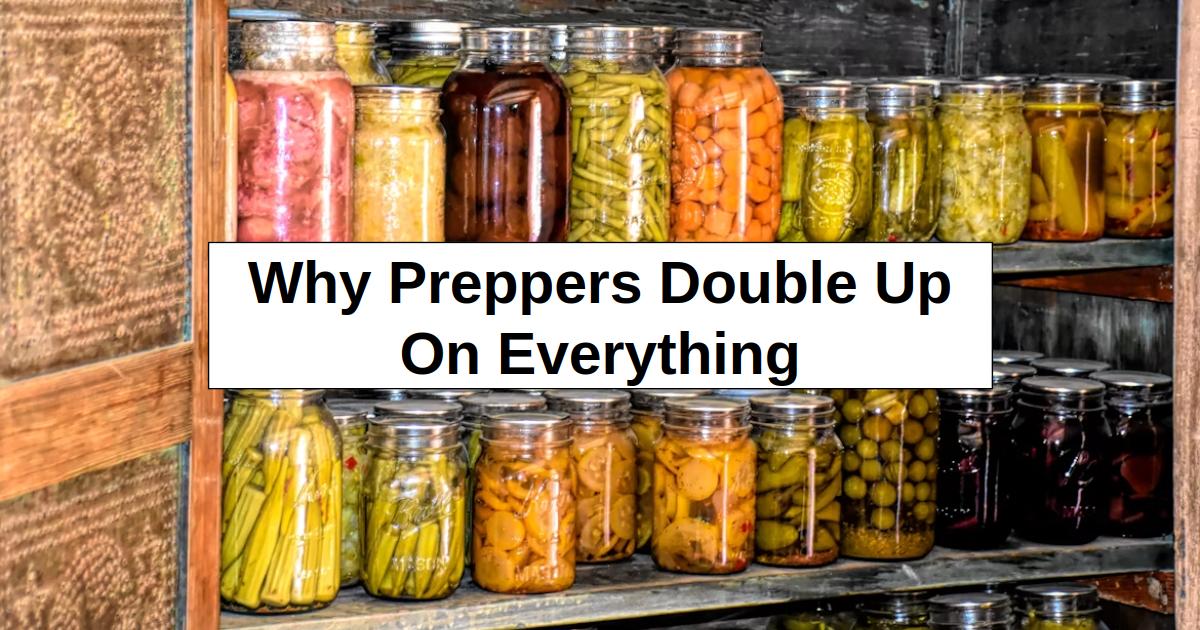
Food stockpiles get the obvious redundancy treatment, including canned goods and long-term storage supplies, like canning jars, Kosher salt, and a ton of extra lids and bands might top the list. Water filters, too.
But it’s the small stuff, the items that make life easier or feel more normal, that surprises newbies; stuff like floss, batteries, sunscreen, paper plates … and a lot more could be added. I’ll leave these items alone for now. The logic here is to buy more of anything under ten dollars that would be awfully annoying not to have should you be unable to replace it.
Here’s another take on the supplies people wish they’d stocked sooner in this video post, and I’m sure a good chunk of it overlaps with exactly this kind of redundancy.
Skills Matter More Than Gear
Gear can be stockpiled endlessly, but none of that replaces knowing how to actually use it and do things. For example, another generator doesn’t help much if you don’t know how to use it safely. Likewise, a backup medical kit doesn’t matter if you don’t know what’s in it or how to use half the supplies.
Skills don’t break, run out of batteries, or need more storage space. They also don’t cost anything once you’ve learned them. If you’re spending money on more gear but haven’t spent time learning first aid, basic repair skills, or how your own equipment actually works, you’ve got your priorities backward.
But even skills can be redundant. After all, there’s often more than one way to get something done. I, for instance, love to discover new ways to make DIY stoves, off-grid power setups, and even basic foodstuffs. There’s a million things you could focus on learning over the next year, so why not make some of them completely new prepping skills? This means stepping outside of your comfort zone! Thus, if you love cooking but would never makeshift a stove, why not give it a try?
Not Everything Matters
Surely, doubling up isn’t worth doing across the board. Like I said, indiscriminate doubling wates money and somtimes just adds more stuff that can fail; spares should be reserved for things that are genuinely critical or hard to replace. A spare firearm or backup power source makes sense. A second coffee maker is probably just another coffeemaker with less space for more useful items … but if you can’t live without your morning coffee, then definitely have a second coffeemaker.
If you’re trying to figure out where to start building a supply list that actually matters, my book on survival supplies walks through what to prioritize instead of just buying more of everything and hoping for the best.
Still, it’s not terribly difficult to figure out on your own. What items must you absolutely have to survive? More specifically, what items, should you be unable to replace them, can you not live without? Is that life-sustaining medications or power for a CPAP machine? If so, figure it out because that’s where your redundancy focus should go.
What’s worth doubling in your setup, and what’s just extra stuff taking up space? Let me know!
Leave a Reply