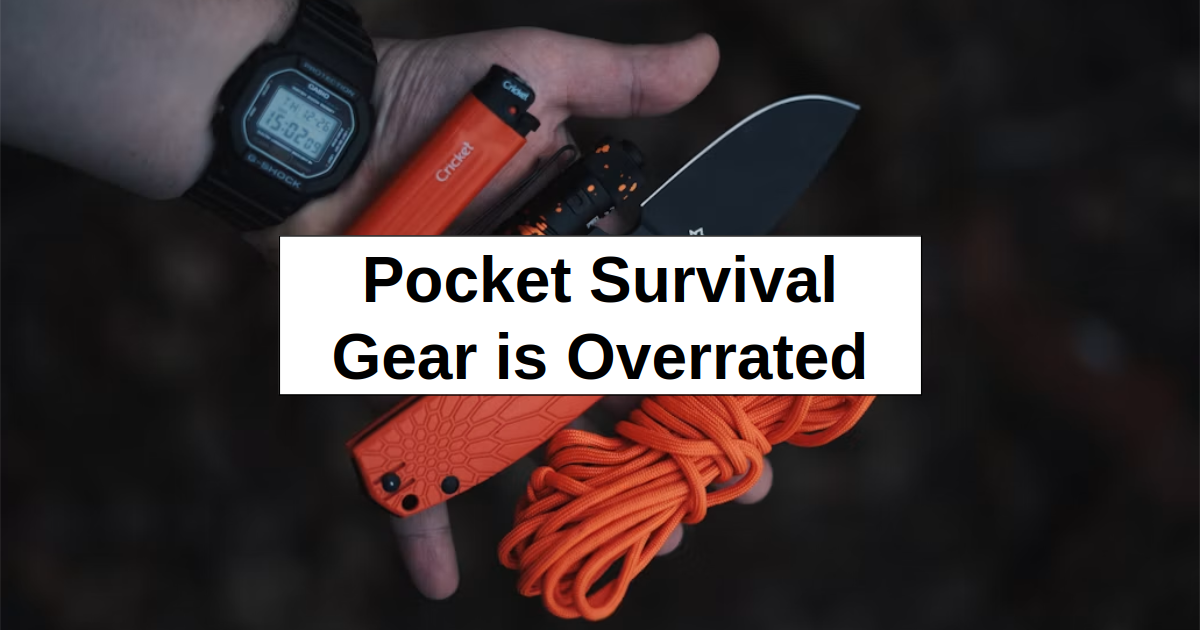
I used to carry a lot. A Leatherman Wave, a pocket knife, my own version of an Altoids tin loaded with wilderness survival gear, a wallet stuffed with extras like bandages and folded duct tape, and more. I once carried wallet survival tools, assorted items on my keychain (which ended up causing problems with the ignition cylinder on a vehicle because it was too heavy), and I even tried a special jacket that had dozens of pockets, all filled with various survival items.
Now it’s just a knife, flashlight, and pill holder on my keychain. Everything else got cut somewhere along the way.
I didn’t plan that shift. It just happened, the same way it happens to most people who start out heavy on gear and end up carrying less as the years go by. For me, it’s probably just a bit of laziness as I age, coupled with knowing that my cars have supplies and I’m rarely too far from home. Hmmm … I’m starting to sound like one of the sheeple again. 😉
There’s a lot of overlap in what people actually carry day to day: wallet, phone, keys, a folding knife, a Bic lighter, usually a Victorinox or a Leatherman, maybe a firearm, person IFAK, and even handcuff keys. (Yeah, I’m not *that* paranoid yet, lol.) Add a little cash tucked behind a card, which I still do now that I think about it along with a backup credit card, and there’s little room for more.
The phone is the interesting one. People forget to even mention it half the time, even though it’s probably the single most-used tool in anyone’s pocket. Maps, flashlight, communication, all in one device most of us touch a hundred times a day. It’s so normal we stop counting it as gear even though we should. (I wrote a book about smartphone survival apps, which I updated not too long ago, if interested.)
Medical Gear Gets Missed
This is the part that surprises people. Prescription meds for heart conditions, anxiety, or blood sugar should show up as often as any knife or flashlight, but they rarely do from what I gather. I’ve only recently started keeping over-the-counter pills on my keychain. Anyway, eye drops may be important too, which I also keep in my pocket.
Basic first aid items like bandages, a tourniquet if you’re super prepared, or sometimes a full IFAK folded down small enough to ride in cargo pants pocket may be of interest, though my IFAK kit is in our primary vehicle.
Some people carry snacks just to manage their blood sugar, which is something many people do without realizing it’s “prepping” in a way.
Redundancy and Location
Some people take redundancy very seriously, even on their person. For instance, a knife on each side of the body shows up as a strategy, the logic being that if one arm gets hurt, you still have a blade you can reach with the other hand. Or, at least, they have multiple weapons within reach, one on each side of the body. I’ve never gone that far, but I get it.
Then there’s the person who breaks his pockets down by exact location. Right front for a pocket knife, left front for daily necessities (keys, wallet, etc.), a firearm as appendix carry, maybe more items in a shirt or jacket pocket, and a multi-tool on their belt.
Maybe you take it a step further, by choosing a folding knife with a built-in fire rod, a penlight / tactical light in the shirt pocket, a thumb drive loaded with personal info (encrypted, of course), and maybe even a small notepad in the back pocket. It can be a lot.
I went the other direction. My old “Altoids tin” setup was my version of packing a lot into a small space, survival basics squeezed into something the size of a deck of cards. There’s a decent video walkthrough of a tin kit if you want to see the idea in action. I don’t carry mine anymore, but I get the appeal for newbies because it’s small and easily carried.
The Problem With Leaning on Your Phone
They’re incredible until they’re not. Have a dead battery because you forgot to charge it last night, no signal because the cell towers lost power, or a cracked screen because it got dropped when you’re in a hurry, and suddenly the one tool doing five jobs does none of them. (And this is coming from somebody who wrote a book about smartphone survival apps!)
But it’s just a tool … a tool that does a lot of useful things for us. For instance, people navigate by phone now almost exclusively, me included. I’m not even sure I could tell you most of the names of the streets I drive around the city. Take the phone away and how many of us could easily get home when put somewhere that’s unfamiliar yet relativley close to home? Probably fewer than we’d like to admit.
I’m not saying ditch the phone at all. I’m saying don’t let it be the only tool in your pocket for anything that actually matters because things break, get lost, and stop working at the worst times. Besides, your phone can’t start a fire, cut rope, or defend you against a bad guy. You need the right tools for the job.
Why Pocket Gear Gets Lighter With Age
Weight and comfort win out eventually. Carrying a lot of gear feels easier at 25 than it does at 50, and a lot of people describe scaling back once heavy pockets stopped being worth the sag in their pants. I get it!
The mindsetir shifts too. Instead of carrying everything on your body, the goal becomes staying a short car trip away from home along with a full get-home bag if you need it. Keep the absolute essentials on you, and the rest close by, and stop trying to be a one-person survival kit.
That’s basically where I landed. I keep the bare minimum essentials on my person; stay close to home; and moved everything else to a get home bag or in the car, because carrying it in my pockets stopped making sense once I actually thought about how often I used it or might actually need it.
Granted, that’s my situation. You might see things differently because of work or where you live, such as in a city. In that case, I would reconsider what I keep on my person, opting for more than not. The Urban Prepper on YouTube is a good source.
What’s actually still in your pockets, and how much of it is left over from a belief that you needed it once upon a time but no longer do?
Leave a Reply