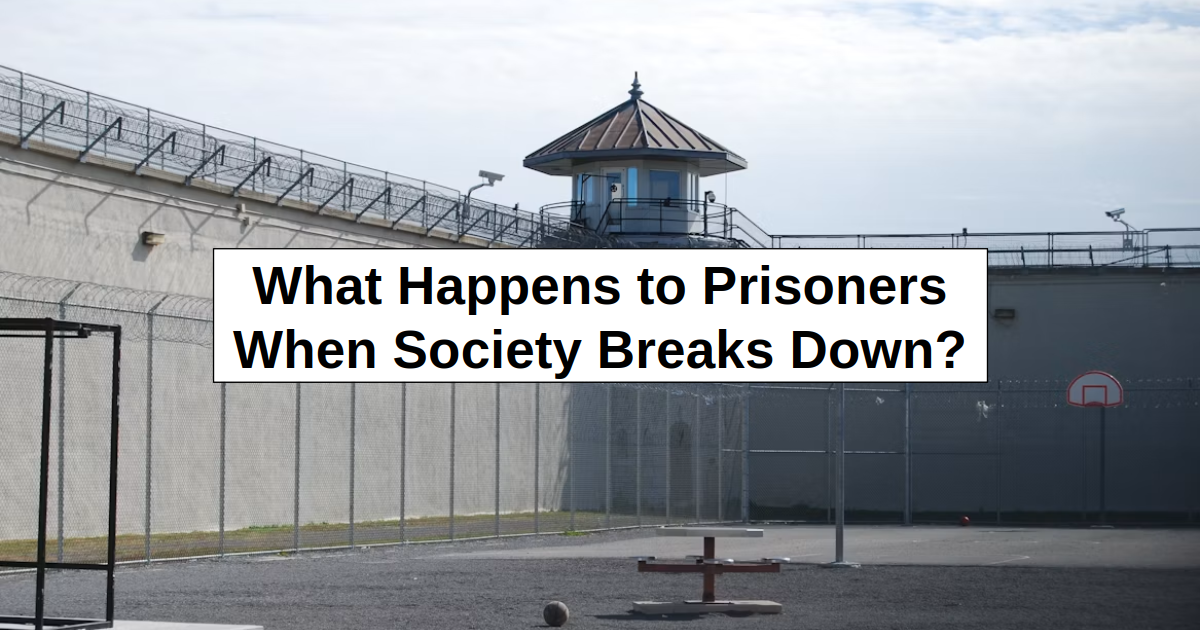
Suppose America suffered a prolonged, widespread disaster. Something like the power grid went down sort of thing, where even police departments struggled to keep officers on duty. Most of us would have our hands full trying to keep our families safe and fed, but there’s another potential problem that I suspect few people have given much thought to: What happens to the millions of people locked inside America’s prisons and jails? And what does that mean for society’s prospects if they escaped during such a disaster?
Prisons depend on many of the same services that the rest of us do. They need electricity, clean water, working toilets, food deliveries, medical care, and employees who show up for work. Take away those things long enough, and even the most secure prison become a real mess.
Would the prisoners be evacuated somewhere else? Would officials release them? Could inmates escape, or would they be left locked inside?
I was curious enough to look into it, and it turns out that parts of this scenario have already happened, both here and overseas. What I found wasn’t encouraging for law-abiding folks.
We’ve Already Seen Prisons Fail During Disasters
The most relevant American example is Hurricane Katrina in 2005. When the storm hit New Orleans, thousands of prisoners were being held at Orleans Parish Prison, the city’s jail complex.
Before the storm, officials decided against evacuating the prisoners. They believed the buildings could withstand the hurricane and that backup generators would keep things running. That didn’t happen.
The generators failed, floodwaters entered the buildings, and the prison lost power. Toilets backed up, ventilation stopped, and prisoners were left without adequate food, drinking water, or medical care. Worse, some correctional officers abandoned their posts, leaving inmates locked inside flooded cells. Prisoners broke windows to get fresh air and even made holes in walls while trying to escape the rising water. Many remained trapped for days before being evacuated.
Think about that for a moment, and consider what you might do in their shoes. Those prisoners couldn’t evacuate like the rest of New Orleans. Their survival literally depended on government officials who were struggling to deal with a disaster themselves. And the situation didn’t necessarily improve once they were moved.
Now, I’m not somebody who thinks prisoners should be getting the red carpet laid out for them, but I’m also not for allowing folks to perish needlessly, either, especially since many of these inmates weren’t in jail for serious offenses. From what I understand, most were being held pending trial, for minor offenses, and other lesser crimes, and not for sentences requiring a lifetime imprisonment. Again, I’m no tree hugging hippie, but I’m not a monster, either.
Of course, Katrina was a regional disaster. Help eventually arrived from elsewhere. But what if that help wasn’t available? We can look overseas for clues.
Haiti’s 2010 Earthquake
When a devastating earthquake struck Haiti in January 2010, the country’s prison system suffered widespread damage. More than 5,000 prisoners escaped following the earthquake, including all 4,215 people held at the National Penitentiary in Port-au-Prince.
Buildings had been damaged, guards were overwhelmed, and the country faced a humanitarian disaster. Maintaining prison security was hardly the only problem authorities had to worry about, and likely near the bottom of the list.
This is an important example because it shows that a prison system doesn’t need to lose electricity to fail. Physical damage and a collapse in law enforcement can produce the same result just as fast.
The Philippines’ 2013 Typhoon
Another example comes from the Philippines, where Super Typhoon Haiyan devastated the city of Tacloban in November 2013.
Flooding overwhelmed the local jail, and powerful water currents damaged the main gate. Guards allowed prisoners out of their cells to reach higher ground, but some inmates escaped through the damaged entrance.
Reports indicated that 103 prisoners remained at large on November 19, although several had already returned voluntarily. Apparently, some had left to check on their families and help them survive the disaster.
I find that last detail interesting because we tend to imagine escaped prisoners immediately turning to crime, but at least a few were more concerned about their families.
Haiti’s 2024 Prison Breaks
Haiti offers another example, although the circumstances were different. In March 2024, armed gangs attacked major prisons in Port-au-Prince while the country struggled with political unrest and widespread violence. Thousands of inmates escaped, and the government declared a state of emergency.
The attacks occurred during a broader breakdown in security, with armed groups challenging the government’s control over the capital. This wasn’t a case of backup generators failing or food deliveries stopping. Instead, armed groups literally attacked the facilities, which I could imagine happening here with so many gang members being imprisoned.
Still, it illustrates another possibility: When law enforcement is overwhelmed by a larger crisis, prisons may become targets of opportunity, since authorities may well lack the resources to defend them. That’s a scary thought!
What Would Happen in America?
There are nearly two million people being held in prisons and jails across the land at any given time. Under normal circumstances, American prisons have emergency plans for fires, hurricanes, riots, and other disasters, but dealing with this many people might be impossible amid a large-scale disaster.
For a temporary and localized emergency, prison officials would likely restrict inmate movement, use backup power, ration supplies as needed, and request outside assistance. If conditions worsened, they might move prisoners to other facilities. Evacuating dozens of prisoners is difficult enough, but moving thousands of inmates requires a massive effort, including many vehicles, armed escorts, secure destinations, and coordination between agencies. I just don’t see that happening during a nationwide emergency, especially if other facilities were suffering from similar problems. So, prisoners would likely stay put.
Staffing might quickly become the biggest issue, since correctional officers have families, too. If their homes lacked power or water, and their children needed help, or local roads became impassable, how many officers would keep reporting to work?
Some would stay, I’m sure; others wouldn’t. My cousin was a correctional officer for years. I’d imagine he would’ve done what he could, but I’d also imagine he would’ve taken care of his family first and foremost if things got that bad.
Would Authorities Release Prisoners?
Possibly. I suspect people held for minor offenses, those nearing the end of their sentences, and some nonviolent offenders would be considered safe enough to release, assuming officials retained the means to identify and release them because, if the power is out, then their records are probably inaccessible, too.
Now, I wouldn’t expect officials to open the gates and release the most dangerous offenders simply because supplies were running low, even if it’s clear that the situation wasn’t going to return to normal. But who knows what officials might do if their political careers might be in jeopardy by allowing a “humanitarian crisis” to unfold inside a prison.
Clearly, some prisoners might remain locked inside facilities that can no longer provide the basics needed to keep them alive. After all, Katrina showed that abandonment can happen even when outside help eventually arrives. I don’t see why it couldn’t happen on a larger scale.
But here’s the part that interested me most, and why I started down this path…
How Likely is Escape?
If prisoners became desperate enough, many would surely attempt to escape. Whether they succeeded would depend on the facility, its physical condition, and how many guards remained.
A widespread power failure would not automatically open prison doors and send inmates pouring into the streets. Security locks can remain locked without electricity. Virginia’s jail standards, for example, require locks to stay secure during power failures; I’m sure other states have similar requirements. Prisoners could effectively remain trapped even after everything stopped working. But additional problems like flooding, fire, structural damage, and certainly the loss of staff would weaken security dramatically.
The chance of escape would depend heavily on the facility and whether guards remained on duty. Some minimum-security federal camps have limited or no perimeter fencing. Thus, if staff abandoned them, escaping could become relatively straightforward. Higher-security prisons have stronger barriers, secure cells, and tighter controls on movement. Those barriers would still matter without guards, although barriers alone cannot keep a prison secure. Such differences suggest greater escape risks at lightly secured facilities, as one would expect.
Where prisoners were located when control broke down would also matter. Someone locked inside an intact cell would face more immediate limits than someone in a shared living area. Groups outside their cells would become harder to control as staffing fell. Still, moving freely within a housing unit is not the same as getting beyond the prison’s outer barriers. Given enough time, however, they would likely get out.
Although there is no obvious basis for claiming that most prisoners would escape during a nationwide collapse, a measure of human control (guards) is surely required to ensure they don’t escape. Remove that crucial component, and it’s only a matter of time in my opinion.
My guess is that a prolonged national disaster would produce a mix of outcomes to where some prisons would remain fairly secure for a long time because that’s how they were designed; others would escape during the disorder in short order.
Preparing If You Live Near a Prison
I wouldn’t lose sleep over the possibility of thousands of prisoners escaping during some hypothetical widespread emergency. America’s prisons aren’t all going to fail because of an ordinary blackout. Still, if you live near a large prison or jail, it’s worth including the possibility of an escape or major disturbance in your emergency plans just in case.
Start by knowing where the facility is located relative to your home. Consider the roads nearby and whether you live along a major route away from the prison. You should also know how your county issues public safety alerts. When we lived in Washington state, there’s a major highway that included one or more signs that warned drivers not to pickup hitchhikers because there was a nearby prison; same goes for a highway we used to frequent in Kansas.
If a serious escape occurred, I’d want to hear about it from law enforcement rather than social media rumors, though it can’t hurt to take even rumors relatively seriously just in case.
I’d also pay attention to basic home security. Solid exterior doors, good locks, secured windows, and working outdoor lights are sensible precautions regardless of whether you live near a prison. Battery-powered cameras or alarms could help during a blackout. But prisoners are likely going to be desperate people, willing to take desperate measures, which means that traditional security measures might not be enough.
Thus, keeping your vehicle fueled and having more than one route out of town makes sense, too. But don’t assume evacuating is always the best choice. If dangerous inmates are reportedly loose nearby, staying inside a locked home might be safer than driving around. It’s hard to say which way I’d lean in such a scenario.
That said, if you encounter someone suspicious, don’t approach or attempt to detain them. Get somewhere safe and contact authorities if communications are available.
More than anything, I’d focus on being ready for the disaster that caused the prison to fail. Store enough drinking water and food to shelter at home without relying on stores. Have backup lighting, a way to receive emergency information, and a plan for your family’s medical needs. You know the deal because if you can comfortably shelter at home while the authorities sort things out, you’ve already reduced your exposure to whatever is happening outside.
And if the situation became so bad that prisons across America were losing power and being abandoned by their staff, escaped inmates would be only one of many concerns because police departments, hospitals, grocery stores, and countless other services would likely be in dire trouble, too. These facilities depend on the same fragile supply chains and public services that the rest of us mostly take for granted.
I don’t know exactly what American officials would do if thousands of prisons and jails reached that point simultaneously. I doubt anyone does. We have examples of individual failures, but nothing that proves how a nationwide breakdown would unfold. I suspect, however, that it won’t much matter because they will get out one way or another. The only question is how long it will take. I’m conservatively guessing less than a week, but less than 48 hours if there are no guards seems like a more reasonable, yet completely unfounded guess on my part.
What do you think? Would prison officials proactively release inmates during a prolonged nationwide disaster, or would most prisoners remain locked inside regardless of the conditions? More importantly, how long would it take for them to escape?
Leave a Reply