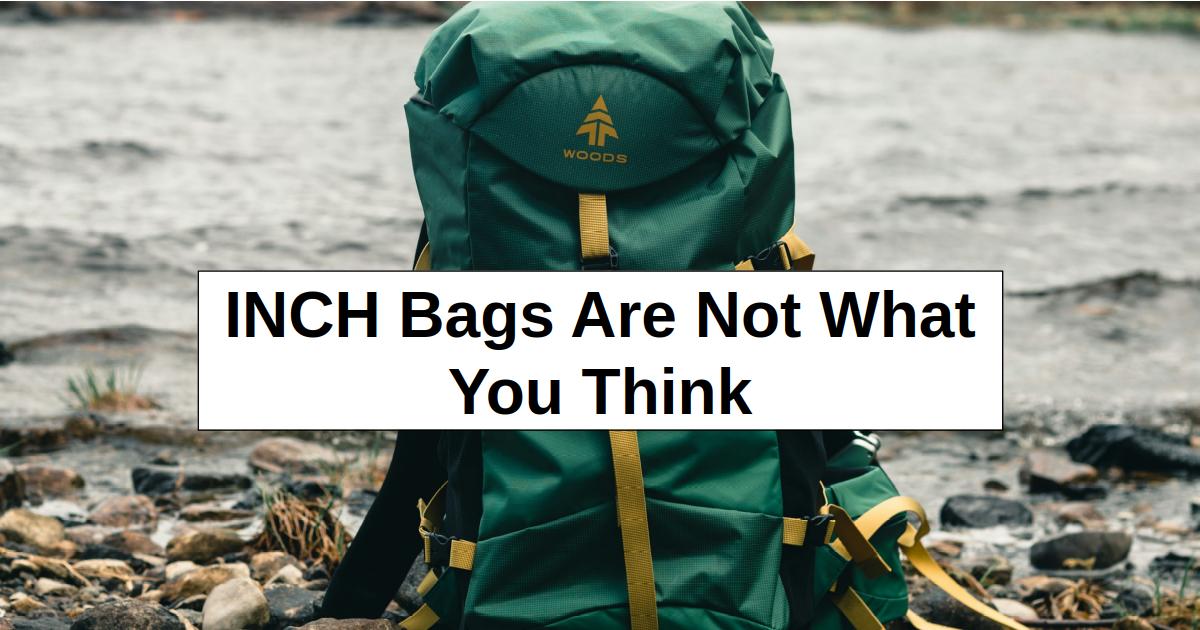
People throw around the term “INCH bag” like it’s just a bigger bug-out bag. It’s not, and that misunderstanding can send you down a pretty expensive, and frankly dangerous, rabbit hole building something that won’t actually work when you need it.
INCH stands for “I’m Never Coming Home.” Four simple words that completely change what you’re trying to do.
Your bug-out bag covers 72 hours, maybe a week if you’re into wilderness treks. The assumption is you’re leaving temporarily, riding out whatever’s happening, and coming back home in relatively short order. I’ve written about what goes into a solid BOB and even admitted why most bug-out bags will be useless when things actually go sideways. But INCH bags are a different animal because you’re not riding anything out… you’re gone. For good!
That word “never” changes everything.
Weight Problems
Think about what you’d actually need to never come home. Enough food to survive until you can grow or source your own, which would be more than what fits in any bag, but let’s keep going. Maybe you’ll take basic tools for shelter and repair. Definitely weapons and ammunition. You likely want medical supplies for months, not days, even if you don’t have serious health problems now. You’ll need spare clothing for multiple seasons, not to mention shoes and boots. Lights, comms, spare supplies, like glasses, batteries, and that’s just the start.
Now put that in a typical hiking backpack and see what fits.
You can’t. And it’s not even close. A serious INCH load-out would break your back and slow you to a crawl. At least, it would for me. This is the core problem with the whole concept, and it’s why most people who have thought hard about it land in the same place: a true INCH kit isn’t a bag at all. It’s a truck, plus a trailer. It’s probably also a cache system buried along your routes, and certainly a stash somewhere safe.
One person I came across runs five steamer trunks staged near his door. Survival gear, camping equipment, weapons, food, and documents, each in its own trunk. His goal is a 5-to-20-minute load time into his truck when things go bad. Another person buried 5-gallon bucket caches every few miles along three separate routes. He wears a light pack on his back and resupply as he moves. A couple I read about keeps most of their preps at a dedicated property outside the city, which is probably the smartest move. Their bags only need to get them there, which is about three days on foot, and is closest to a bug out bag.
They’re are the most honest answers to what an INCH bag actually is.
Did You Forget Something?
Gear gets all the attention. Documents almost never do.
Property deeds, passports, identification, bank records, birth certificates, and bunch more. Even if you’re “never coming home,” you may still need to prove who you are and what you own at some point because, after all, the entire point of survival is to get back to a normal life, which I’ll assume includes some of these documents.
An encrypted thumb drive or SD card with scanned copies of everything fits in your shirt pocket and might be the single most important thing in your kit at some point down the road. A fireproof portable document safe that goes in the truck first is even better if you have paper copies, which you should.
I’ll admit I hadn’t thought much about this until I started reading through how others approach it. Most of us spend hours agonizing over knives and fire starters and even unusual items for the bag and then completely ignore the folder of papers that could make or break life on the other side of SHTF.
Maybe. Who knows how things play out, of course.
INCH Bags Are Their Own Things
Here’s the framing that actually made sense to me. INCH isn’t something you build from scratch alongside your bug-out bag. Instead, it’s the far end of a spectrum.
You start with your EDC, everyday carry. Then a get-home bag. Then your BOB. Then a vehicle load. Then a full INCH setup if you get that far. Each layer covers a longer timeline and a worse scenario. If you lose a layer, you fall back to the next one. Your INCH kit is just what your whole system becomes when returning home is off the table.
That framing takes a lot of pressure off because you don’t actually need a magical bag that holds everything. You need a system where each piece supports the next, and where the vehicle or property at the end of the chain carries what no backpack truly can.
What Matters Most
A few people who’ve done real forced evacuations–wildfires–the kind where you don’t get to decide whether to leave, all said the same thing: The bag matters less than you think. In fact, having a destination matters more than anything in the bag.
Because if you don’t know where you’re going, no amount of gear fixes that. A fully stocked truck pointed nowhere is just a slow-moving target.
So before you spend another hour agonizing over what goes in an INCH kit, ask yourself a simpler question first: if you left tonight and couldn’t come back, where would you go? And how would you get there if things went truly sideways?
If you don’t have a solid answer to these questions, start there, even before developing a bug out bag.
What does your INCH setup look like? Are you working toward a vehicle-based system, a bug-out property, something else entirely? I’d like to hear what’s actually working for people who have thought this through.
Leave a Reply